
University of Georgia Athletics
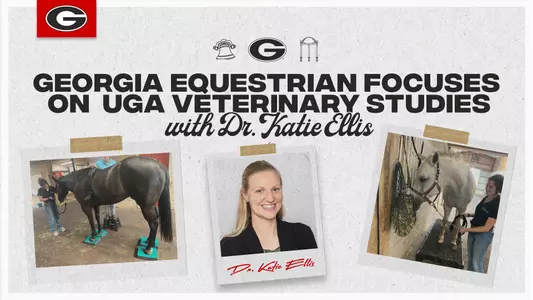
Georgia Equestrian Focuses on UGA Veterinary Studies
February 21, 2024 | Equestrian
By: Julia Maenius
Over 100 athletes walk the ground of the UGA Equestrian Complex each day. Some athletes stand on two legs, while others graze the field on four. With 52 horses on the roster for the equestrian team, there is a need for additional care and emphasis on equine athlete rehabilitation.
The University of Georgia College of Veterinary Medicine has been working with the UGA equestrian team in recent years to conduct equine research. Clinical Assistant Professor Dr. Katie Ellis has partnered with the equestrian team on two published studies as a teaching element in the Department of Large Animal Science.
Dr. Ellis' work with the equestrian team began in 2020. She has led studies and worked with research students on noninvasive projects centered around the horses with the team as the subjects.
"The other thing that has been a benefit to having students learn is they have been more than willing to let us use the horses for very clinical, noninvasive research studies," she said. "My area of specialty is equine sports medicine and rehabilitation. "
Ellis has focused her research and studies with the equestrian team on the utilization of varying rehab tools to assess the benefits of therapy practices.
"There have been so many benefits to us, and hopefully we are providing high quality care to all of the equine athletes that are out at the barn," Dr. Ellis said. "For us, they have been phenomenal. Having the ability to teach students using the horses, they are wonderful about letting students practice both technical and clinical skills that not all clients are amenable to having students learn. That is a huge benefit."
The basis of Ellis' research is to aid horses in their recovery from injury and help them perform their jobs comfortably and effectively. The Department of Large Animal Medicine has conducted two published studies in the Journal of Equine Rehabilitation and The Official Journal of the American College of Veterinary Radiology.
"We have had two completed published studies that have been done," Dr. Ellis said. "One was the Equiband study. The other was an imaging project for a student. This past summer, we did some date collection on whole-body vibration therapy that we used the horses for. Last month, we had another student who was looking for an imaging project, so we used some of the horses for that as well. I have four different projects that we have been able to use the horses."
Ellis and her team worked to study the effect a resistance training regime on non-performance limiting hindlimb lameness.
"The biggest one was the Equiband study that talks about the effectiveness of a four-week elastic resistance band regimen," Dr. Ellis said. "The Equiband is a saddle pad that has clips on it. Attached to those clips are stretchy, elastic resistance bands similar to TheraBands that people use to do resistance training."
The bands used provided stimulus to the horse to engage it core muscles and hind end. Using eight horses, the research team used a graduated handwalking protocol to study if this regime improved lameness. The study showed that the horses changed some of their hind end gaits.
"For the type of research that I like to do, for it to be really clinically relevant, it is good to have horses that are doing athletic ridden work to see a major difference," Dr. Ellis said. "The other really nice thing is because they have quarter horses and warmbloods, we can look at breed differences."
The second study Ellis was part of focused on the ultrasounding of warmblood and quarter horses to examine ligament characteristics in the horse's stifle based on breed. Ellis leads fourth-year students through their research to study issues in equine medicine.
"It has been a great working relationship we have had with them," Dr. Ellis said. "It speaks volumes to the fact that they want us to be able to do some of this research to help train the next equine veterinarian, which we are desperately in need of. They are really helping young veterinarians get confident in their skills and hopefully retain them in the equine industry, so we have more people to care for horses overall."
Over 100 athletes walk the ground of the UGA Equestrian Complex each day. Some athletes stand on two legs, while others graze the field on four. With 52 horses on the roster for the equestrian team, there is a need for additional care and emphasis on equine athlete rehabilitation.
The University of Georgia College of Veterinary Medicine has been working with the UGA equestrian team in recent years to conduct equine research. Clinical Assistant Professor Dr. Katie Ellis has partnered with the equestrian team on two published studies as a teaching element in the Department of Large Animal Science.
Dr. Ellis' work with the equestrian team began in 2020. She has led studies and worked with research students on noninvasive projects centered around the horses with the team as the subjects.
"The other thing that has been a benefit to having students learn is they have been more than willing to let us use the horses for very clinical, noninvasive research studies," she said. "My area of specialty is equine sports medicine and rehabilitation. "
Ellis has focused her research and studies with the equestrian team on the utilization of varying rehab tools to assess the benefits of therapy practices.
"There have been so many benefits to us, and hopefully we are providing high quality care to all of the equine athletes that are out at the barn," Dr. Ellis said. "For us, they have been phenomenal. Having the ability to teach students using the horses, they are wonderful about letting students practice both technical and clinical skills that not all clients are amenable to having students learn. That is a huge benefit."
The basis of Ellis' research is to aid horses in their recovery from injury and help them perform their jobs comfortably and effectively. The Department of Large Animal Medicine has conducted two published studies in the Journal of Equine Rehabilitation and The Official Journal of the American College of Veterinary Radiology.
"We have had two completed published studies that have been done," Dr. Ellis said. "One was the Equiband study. The other was an imaging project for a student. This past summer, we did some date collection on whole-body vibration therapy that we used the horses for. Last month, we had another student who was looking for an imaging project, so we used some of the horses for that as well. I have four different projects that we have been able to use the horses."
Ellis and her team worked to study the effect a resistance training regime on non-performance limiting hindlimb lameness.
"The biggest one was the Equiband study that talks about the effectiveness of a four-week elastic resistance band regimen," Dr. Ellis said. "The Equiband is a saddle pad that has clips on it. Attached to those clips are stretchy, elastic resistance bands similar to TheraBands that people use to do resistance training."
The bands used provided stimulus to the horse to engage it core muscles and hind end. Using eight horses, the research team used a graduated handwalking protocol to study if this regime improved lameness. The study showed that the horses changed some of their hind end gaits.
"For the type of research that I like to do, for it to be really clinically relevant, it is good to have horses that are doing athletic ridden work to see a major difference," Dr. Ellis said. "The other really nice thing is because they have quarter horses and warmbloods, we can look at breed differences."
The second study Ellis was part of focused on the ultrasounding of warmblood and quarter horses to examine ligament characteristics in the horse's stifle based on breed. Ellis leads fourth-year students through their research to study issues in equine medicine.
"It has been a great working relationship we have had with them," Dr. Ellis said. "It speaks volumes to the fact that they want us to be able to do some of this research to help train the next equine veterinarian, which we are desperately in need of. They are really helping young veterinarians get confident in their skills and hopefully retain them in the equine industry, so we have more people to care for horses overall."
Georgia Equestrian SEC Championship vs. Texas A&M Postgame Sound
Saturday, March 28
Georgia Equestrian SEC Semifinal vs. South Carolina Video Recap
Friday, March 27
Georgia Equestrian - Lantz Family Feature
Monday, March 02
Georgia Equestrian vs Auburn - Postgame Interview
Saturday, February 28