
University of Georgia Athletics
40-for-80 The Sweetest Season - Notre Dame Game
November 24, 2020 | Football
By: Jeff Dantzler
January 1, 1981
Louisiana Superdome
New Orleans, La.
Georgia - 17, Notre Dame - 10
This was our finest hour.
It was the most important day and greatest victory in Georgia football history. For the sons and daughters of the red and black, January 1, 1981, is the pinnacle. The Bulldogs greatest team put the finishing touches on a magical 12-0 journey to the national championship with a 17-10 Sugar Bowl victory over the fabled Notre Dame Fighting Irish.
At the time, no school had a legacy that could rival Notre Dame's, ripe with championships, Heisman Trophies, the Four Horsemen, and the lore of Knute Rockne and the Gipper. In fact, the President-Elect, Ronald Reagan, played George Gipp in "The Knute Rockne Story."
Notre Dame had won 10 national championships, most recently in 1977 under coach Dan Devine, on the Irish sidelines for this Sugar Bowl, and boasted six Heisman Trophy winners.
"One of the things I remembered, when Notre Dame came on the field, and you hear "Wake up the Echoes," recalls senior rover Chris Welton, "you realize it's the fight song for about half the high schools we played against in high school."
That was the reach of Notre Dame.
An enormous offensive line, which did a great job opening holes for their outstanding running back Phil Carter, was a huge strength. The pass-catchers, Tony Hunter and Pete Holohan in particular, were talented and big. They had a tough defense, led by linebacker Bob Crable and safety Dave Duerson. This stingy bunch had not allowed a 100-yard rusher all season.
Notre Dame came in at 9-1-1. There was the upset tie at Tech on the same day as Buck Belue to Lindsay Scott, and, a week after Georgia had beaten the Yellow Jackets to go 11-0 and the Sugar Bowl match-up was set, the Irish fell to Southern Cal in Los Angeles. Notre Dame's biggest win was a 7-0 victory at Alabama. The Irish opened the season with four straight wins over Purdue, Michigan, Michigan State and Miami. Then came three consecutive dominant performances against Army (30-3), at Arizona (20-3) and Navy (33-0), that pushed the Irish to the No. 1 ranking.
Then came that fateful day of November the 8th.
Georgia was No. 1.
This Bulldogs team had it all.
Outstanding in all three phases, this was a confident, close knit team that believed it would win.
The 11-0 Bulldogs needed to beat Notre Dame to claim the first undisputed national championship in school history. The Bulldogs were consensus national champions in 1942 and were voted No. 1 in at least one poll in 1927, 1946 and 1968.
It was fitting that college football's most storied program stood in the path of the Bulldogs greatest triumph. The great Erk Russell - "Men, just one more time."
Game Time
All-American kicker Rex Robinson booted the kickoff into the end zone, and after all the buildup and hype, it was finally game time.
The Irish took over on their own 20-yard line and promptly drove 48 yards in nine plays to the Georgia 32. The Bulldogs defense stiffened, and Notre Dame called on kicker Harry Oliver. He hit it from 50.
It would be his lone make on four attempts that fateful New Year's afternoon in the Superdome.
On Georgia's second play from scrimmage, Herschel was hit by Duerson on the right sideline. His shoulder popped out of place and he left the game.
The team doctors said it was dislocated, he couldn't go back in, and that surgery would be required.
"We had come all this way, and Herschel comes out, and I remember thinking, well, we're going to have to do it without him," recalls legendary Bulldogs coach Vince Dooley.
Herschel had a different take.
"We came all this way, I wasn't not going to play," he said. "I said, if something's out of place, let's get it back in place, rub some dirt on it, and play."
The trainers and doctors did just that.
And play Herschel would.
Leave it to another freshman to turn the game in Georgia's way.
Herschel Walker was the most heavily recruited player in the country. Terry Hoage was the most lightly recruited player in Georgia's freshman class. His other scholarship offer came from Dartmouth. Both would of course go on to the College Football Hall of Fame.
Hoage had barely played all season but had made a mark on the field goal block team in practices leading up to the showdown with the Irish. "Pack your bag," Dooley told him, "you're coming to New Orleans with us."
Notre Dame had driven to the Georgia 31. Senior defensive end Robert Miles knocked down Irish quarterback Blair Kiel's aerial attempt, and Notre Dame turned to Oliver for another field goal attempt.
Following the lead of senior captain Frank Ros, who had a superb performance in his final game as a Bulldog, the future two-time All-American Hoage blew through the middle and blocked the field goal. Georgia took over at the Notre Dame 49, and the Bulldogs were in business, and then some.
With his shoulder popped back into place, Herschel came back on the field.
He ran for seven. He ran for seven more. He ran for eight and then seven more behind the great Bulldogs offensive line, as Georgia moved to the 18. But the Notre Dame defense came up with a big play, sacking quarterback Buck Belue on third and eight for a loss of 11.
It was time for Rex. Bingo! The All-American split the uprights from 46 yards out and the game was tied 3-3 with 1:45 to go in the first quarter.
Georgia led the nation in turnover margin in 1980, and was the country's best collective special teams unit.
Fate then smiled on Georgia, and the Bulldogs capitalized.
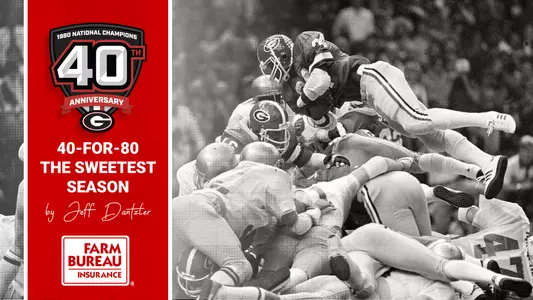
Notre Dame misplayed Robinson's kickoff, and the Kelly brothers Bob and Steve were there for the big play. Georgia had the ball! Georgia had the ball! The Bulldogs were sitting on the Notre Dame one. Two plays later, Superman went over the top and Georgia led Notre Dame. Robinson's extra point gave the Bulldogs a 10-3 advantage with 1:04 to go in the first quarter.
Pat McShea came up with a sack on Notre Dame's following possession. Georgia took over on its 38 after a nine-yard punt return from Scott Woerner, the game's Defensive Most Valuable Player.
Georgia nearly scored on the final play of the first quarter, but Norris Brown and Buck Belue couldn't hook up on a long pass. The Bulldogs couldn't move the chains, and Mark Malkiewicz punted 59 yards into the Irish end zone.
Second Quarter
The Bulldogs great defense came through with the big play, and it was a couple of seniors who came up with the turnover. On first down from the 20, Ros hit fullback John Sweeney, knocking loose the pigskin, which was recovered by Chris Welton at the Notre Dame 22-yard line.
Ros had 10 tackles and the forced fumble. Welton, on the biggest of stages, had the greatest game of his career, recovering the fumble, knocking away two passes, and recording ten tackles - ten solo stops.
Ros played in the game with a bad bruise on his backside, received in practice from Hoage and fellow freshman Freddie Gilbert - future All-American and state high hurdles champion - using him as a catapult on the field goal block unit.
Welton tore cartilage in his knee in the second quarter.
"Seven defensive starters had surgery the next week," recalls Welton, "but nobody came out of the game."
Toughness.
TEAM.
The superb offensive line - led by Nat Hudson, Tim Morrison, Hugh Nall, Jim Blakewood, Jeff Harper, Wayne Radloff and Joe Happe - met the challenge of the stout Irish front head on. After all, they had gone head to head with Eddie "Meat Cleaver" Weaver, Jimmy Payne, Tim Crowe (who had an epic hit in the Sugar Bowl), Miles, McShea, Freddie Gilbert, Joe Creamons, Tim Parks, and Dale Carver.
Iron sharpens Iron.
So, the Bulldogs had the ball first and ten on the Notre Dame 22.
Give Herschel Walker the ball.
He went off right tackle for 12 yards.
Wide side, left side, Belue swept for seven.
Wide side, right side, toss sweep right to Herschel. The line got the push, and fullback Jimmy Womack delivered the epic block of all-time, de-cleating an Irish defender sending him backwards some several yards to spring the freshman sensation for a three-yard touchdown.
Robinson's extra point was true, and with 13:49 to go in the second quarter, Georgia led Notre Dame 17-3.
Hang on Dawgs.
Great teams cash in, and great teams respond.
Georgia had done the former, Notre Dame was doing the latter.
In nine plays, Notre Dame, which switched to Mike Courey at quarterback, drove to the Georgia 13. Senior All-American safety Jeff Hipp, who had nine tackles against the Irish, future All-American Payne, Creamons, and sophomore cornerback Dale Williams all had important stops. Payne and Creamons teamed on a loss of four on second and five.
Notre Dame called time, facing fourth and three from the 13.
Courey threw high for 6-4 tight end Pete Holohan, who would go on to play 12 years in the NFL, in the front corner of the end zone.
The big play man Woerner came through again.
Woerner climbed the ladder and intercepted the pass, returning it 19 yards in an attempt to duplicate his legendary Clemson feat of 98.
Walker carried four straight times, popping a game-long run of 23 yards to the Irish 44. But the drive would stall.
The teams exchanged punts the rest of the second quarter. Georgia actually got to the 50 with just under a minute to go but couldn't move any further. The Bulldogs did not complete a pass in the first half.
At intermission, Georgia led Notre Dame 17-3.
There were 30 minutes separating the Bulldogs from the national championship dream.
Third Quarter
Georgia got the ball to start the second half and got a first down, but a sack got the 'Dogs behind the chains.
Kiel was back in at quarterback for the Irish. The two teams again exchanged punts.
Notre Dame took over on its 40 with 9:41 to go. The Irish would move to the Georgia 13 - the yard line Notre Dame scrimmaged from when Woerner came up with the pick earlier in the game. This time, the Irish turned to Oliver again.
No doubt shaken by Hoage's block, he missed wide right from 30 yards out.
Bullet dodged.
Nothing doing for Georgia.
The Irish then woke up the echoes.
Notre Dame drove 57 yards on 11 plays, with Carter scoring from a yard out. With 54 seconds to go in the third quarter, Notre Dame, after Oliver's PAT, had cut Georgia's lead to 17-10.
The third quarter ended horribly. On third and seven from the 27, Belue was sacked for a loss of 20 yards.
Fourth Quarter
Georgia, clinging to a 17-10 lead, began the fourth quarter punting on fourth-and-27 from its own seven.
Malkiewicz got off a 47-yard beauty, fair caught by Duerson.
Remember, Georgia gave up only eight total punt return yards on the season - two on this day - while Woerner averaged 15.7 yards per punt return in 1980.
The Irish, trying to tie, marched to the Georgia 21. Sophomore linebacker Nate Taylor, a former walk-on who had 12 tackles against the Irish, was in the thick of the battle. Future All-SEC standout Tommy Thurson, an understudy as a freshman at linebacker, also had valuable snaps, registering four stops.
Georgia was fighting to hang on.
Woerner then came up big again.
On third and three from the Georgia 20, he anticipated the toss sweep, and got Carter for a loss of one at right tackle.
The Irish turned to Oliver.
No good! No good! No good!
He missed wide left from 38, again, Hoage and the block from the first quarter influencing the play.
An unsportsmanlike conduct penalty against the Irish gave the Bulldogs a valuable first down. But there would be no more. Notre Dame was focused on Walker, and Georgia still hadn't completed a pass.
The Bulldogs also hadn't turned the ball over.
Notre Dame took over on its own 27. Standout end Tony Hunter was called for offensive interference, pushing the Irish back to their 17. Kiel was then intercepted on the Irish 37 by senior Mike Fisher - who also sealed the win over Florida with a precious pick.
Georgia took over at the Notre Dame 37 but could not pick up a first down. Unable to connect on a field goal, the Irish dodged a bullet.
It was still 17-10. There was 7:29 to go.
Woerner broke up passes on first and ten, and third and two.
Whew.
Kiel, pulling double duty, punted to Woerner, pulling double duty. He fair made the fair catch at the 23 with 6:32 to go.
With Crable leading the Irish defense, Georgia couldn't move the ball.
Malkiewicz punted to the Notre Dame 43. It was a 36-yard punt, with no return.
There was 5:10 on the clock.
Notre Dame got seven to the 50 on first down.
"Meat Cleaver" Weaver then delivered one of the big plays of the game, sacking Kiel for a loss of four.
On third and seven, Welton had the big stop, making the tackle on the 48 for a gain of six. A yard short.
It was fourth and one.
Kiel went back to pass, and Woerner, on what would be the final play of his storied collegiate career intercepted Kiel's pass on the 34-yard line. The brilliant broadcast team of Keith Jackson and Frank Broyles called the game for ABC. When Woerner made the big play, Broyles, the legendary Arkansas coach called it - "Scott Woerner is a winner!"
My God there was 2:56 to go and the Dogs had the ball leading Notre Dame 17-10.
It's a crime that due to broadcast contract situations that Larry Munson didn't broadcast the Sugar Bowl. A damn crime.
Fittingly, Georgia took over on its own 34.
Belue ran for six yards on first down but was knocked out of bounds to stop the clock. Then it was No. 34 for one yard. Notre Dame called time with 2:42 to go.
It was third and three.
Belue then came through in the clutch. With the Irish keying on Herschel, the All-SEC junior quarterback from Valdosta rolled left for six yards and a first down.
Notre Dame stopped the 'Dogs for no gain and called time with 2:16 to go. On second and ten, the incomparable freshman ran for three yards.
It was third and seven from the 50.
Perfect! Timing!
Belue hit Amp Arnold for a seven-yard gain along the right sideline for a first down. It was Georgia's first and only completion of the day. It was the one that mattered.
The game was now in Georgia's grasp.
"When I made the catch, and went down with the first down," Arnold remembers, "I had a big smile, because I knew what it meant."
Notre Dame jumped offsides.
It was first and five from the 38. Herschel ran for nine yards and a first down.
The clock showed 88 seconds.
Herschel went right for five.
Georgia was penalized for delay of game.
A mass of red and black humanity was assembled to charge the Superdome field.
Buck fell on the ball for a loss of one, and Notre Dame called its final time out.
On third and 11 from the Irish 30, Buck rolled left for a gain of four. The Irish were out of timeouts.
Georgia didn't have to run another play.
The clock struck 0:00.
The game was over.
Post Game
Georgia had done it.
A sea of red and black immediately engulfed the playing field as Vince Dooley was hoist on his players shoulders.
"When all the Georgia fans came over the wall before the end of the game, Marianne was standing amongst them," said Woerner, referencing his girlfriend and future wife. "I am standing on the sidelines holding the ball from my last play in college football in one arm, and Marianne, who has jumped the wall in the other. I am a lucky man to still have both of them."
The dream had come true.
"At the final buzzer, the sea of Red and Black storming the field was unreal," recalls Nall. "I will never forget that thrill of a National Championship and seeing that many fans excited for the Dawgs!"
Herschel Walker was voted the game's Most Valuable Player. He carried 36 times for 150 and posted the two touchdowns. Womack and Carnie Norris each had two yards rushing, and of course there was the seven-yard Belue to Arnold connection. Due to lost yardage on sacks - Belue gained 24 yards rushing, but Notre Dame had sacks totaling 58 yards in losses.
Georgia's total offense was 127 yards.
Notre Dame's total offense was 328.
The first down count was an inverse of the final score, 17-10 in the Irish's favor.
But the turnover count was 4-0 in Georgia's favor, plus the misplayed kickoff. The Bulldogs tallied 44 total return yards, the Irish two.
"When it was over, we got back to the hotel, I just sat down on a bench," recalls do-everything Bulldogs assistant coach and standout offensive lineman for the 1966 SEC Champions John Kasay. "I could finally rest and relax because we had done it."
With the sheer ecstasy, jubilation, and relief, there were other emotions for this greatest Georgia team.
"It was kind of sad when it was over," remembers Walker. "We had done it, and accomplished the goal, but all the seniors would be leaving and we knew this special group wouldn't all be together again."
That included the great Erk Russell. He would soon leave to start the program at Georgia Southern - his legacy forever etched in Bulldogs lore.
Dooley, who had turned down a flirtation with his alma mater of Auburn, was named the National Coach of the Year. This victory, this National Championship was the crown jewel of his Hall of Fame career.
It was not the Bulldogs grandest performance of 1980, but the Sugar Bowl victory epitomized what made this Georgia team so great. They found a way - "just one more time." Every time in 1980 the Bulldogs found a way.
"There are very few people who get to say they were a part of something where they were the best in the world," says Captain Ros. "We got to say that in 1980. The Georgia Bulldogs, we were the greatest college football team in the world."
January 1, 1981
Louisiana Superdome
New Orleans, La.
Georgia - 17, Notre Dame - 10
This was our finest hour.
It was the most important day and greatest victory in Georgia football history. For the sons and daughters of the red and black, January 1, 1981, is the pinnacle. The Bulldogs greatest team put the finishing touches on a magical 12-0 journey to the national championship with a 17-10 Sugar Bowl victory over the fabled Notre Dame Fighting Irish.
At the time, no school had a legacy that could rival Notre Dame's, ripe with championships, Heisman Trophies, the Four Horsemen, and the lore of Knute Rockne and the Gipper. In fact, the President-Elect, Ronald Reagan, played George Gipp in "The Knute Rockne Story."
Notre Dame had won 10 national championships, most recently in 1977 under coach Dan Devine, on the Irish sidelines for this Sugar Bowl, and boasted six Heisman Trophy winners.
"One of the things I remembered, when Notre Dame came on the field, and you hear "Wake up the Echoes," recalls senior rover Chris Welton, "you realize it's the fight song for about half the high schools we played against in high school."
That was the reach of Notre Dame.
An enormous offensive line, which did a great job opening holes for their outstanding running back Phil Carter, was a huge strength. The pass-catchers, Tony Hunter and Pete Holohan in particular, were talented and big. They had a tough defense, led by linebacker Bob Crable and safety Dave Duerson. This stingy bunch had not allowed a 100-yard rusher all season.
Notre Dame came in at 9-1-1. There was the upset tie at Tech on the same day as Buck Belue to Lindsay Scott, and, a week after Georgia had beaten the Yellow Jackets to go 11-0 and the Sugar Bowl match-up was set, the Irish fell to Southern Cal in Los Angeles. Notre Dame's biggest win was a 7-0 victory at Alabama. The Irish opened the season with four straight wins over Purdue, Michigan, Michigan State and Miami. Then came three consecutive dominant performances against Army (30-3), at Arizona (20-3) and Navy (33-0), that pushed the Irish to the No. 1 ranking.
Then came that fateful day of November the 8th.
Georgia was No. 1.
This Bulldogs team had it all.
Outstanding in all three phases, this was a confident, close knit team that believed it would win.
The 11-0 Bulldogs needed to beat Notre Dame to claim the first undisputed national championship in school history. The Bulldogs were consensus national champions in 1942 and were voted No. 1 in at least one poll in 1927, 1946 and 1968.
It was fitting that college football's most storied program stood in the path of the Bulldogs greatest triumph. The great Erk Russell - "Men, just one more time."
Game Time
All-American kicker Rex Robinson booted the kickoff into the end zone, and after all the buildup and hype, it was finally game time.
The Irish took over on their own 20-yard line and promptly drove 48 yards in nine plays to the Georgia 32. The Bulldogs defense stiffened, and Notre Dame called on kicker Harry Oliver. He hit it from 50.
It would be his lone make on four attempts that fateful New Year's afternoon in the Superdome.
On Georgia's second play from scrimmage, Herschel was hit by Duerson on the right sideline. His shoulder popped out of place and he left the game.
The team doctors said it was dislocated, he couldn't go back in, and that surgery would be required.
"We had come all this way, and Herschel comes out, and I remember thinking, well, we're going to have to do it without him," recalls legendary Bulldogs coach Vince Dooley.
Herschel had a different take.
"We came all this way, I wasn't not going to play," he said. "I said, if something's out of place, let's get it back in place, rub some dirt on it, and play."
The trainers and doctors did just that.
And play Herschel would.
Leave it to another freshman to turn the game in Georgia's way.
Herschel Walker was the most heavily recruited player in the country. Terry Hoage was the most lightly recruited player in Georgia's freshman class. His other scholarship offer came from Dartmouth. Both would of course go on to the College Football Hall of Fame.
Hoage had barely played all season but had made a mark on the field goal block team in practices leading up to the showdown with the Irish. "Pack your bag," Dooley told him, "you're coming to New Orleans with us."
Notre Dame had driven to the Georgia 31. Senior defensive end Robert Miles knocked down Irish quarterback Blair Kiel's aerial attempt, and Notre Dame turned to Oliver for another field goal attempt.
Following the lead of senior captain Frank Ros, who had a superb performance in his final game as a Bulldog, the future two-time All-American Hoage blew through the middle and blocked the field goal. Georgia took over at the Notre Dame 49, and the Bulldogs were in business, and then some.
With his shoulder popped back into place, Herschel came back on the field.
He ran for seven. He ran for seven more. He ran for eight and then seven more behind the great Bulldogs offensive line, as Georgia moved to the 18. But the Notre Dame defense came up with a big play, sacking quarterback Buck Belue on third and eight for a loss of 11.
It was time for Rex. Bingo! The All-American split the uprights from 46 yards out and the game was tied 3-3 with 1:45 to go in the first quarter.
Georgia led the nation in turnover margin in 1980, and was the country's best collective special teams unit.
Fate then smiled on Georgia, and the Bulldogs capitalized.
Notre Dame misplayed Robinson's kickoff, and the Kelly brothers Bob and Steve were there for the big play. Georgia had the ball! Georgia had the ball! The Bulldogs were sitting on the Notre Dame one. Two plays later, Superman went over the top and Georgia led Notre Dame. Robinson's extra point gave the Bulldogs a 10-3 advantage with 1:04 to go in the first quarter.
Pat McShea came up with a sack on Notre Dame's following possession. Georgia took over on its 38 after a nine-yard punt return from Scott Woerner, the game's Defensive Most Valuable Player.
Georgia nearly scored on the final play of the first quarter, but Norris Brown and Buck Belue couldn't hook up on a long pass. The Bulldogs couldn't move the chains, and Mark Malkiewicz punted 59 yards into the Irish end zone.
Second Quarter
The Bulldogs great defense came through with the big play, and it was a couple of seniors who came up with the turnover. On first down from the 20, Ros hit fullback John Sweeney, knocking loose the pigskin, which was recovered by Chris Welton at the Notre Dame 22-yard line.
Ros had 10 tackles and the forced fumble. Welton, on the biggest of stages, had the greatest game of his career, recovering the fumble, knocking away two passes, and recording ten tackles - ten solo stops.
Ros played in the game with a bad bruise on his backside, received in practice from Hoage and fellow freshman Freddie Gilbert - future All-American and state high hurdles champion - using him as a catapult on the field goal block unit.
Welton tore cartilage in his knee in the second quarter.
"Seven defensive starters had surgery the next week," recalls Welton, "but nobody came out of the game."
Toughness.
TEAM.
The superb offensive line - led by Nat Hudson, Tim Morrison, Hugh Nall, Jim Blakewood, Jeff Harper, Wayne Radloff and Joe Happe - met the challenge of the stout Irish front head on. After all, they had gone head to head with Eddie "Meat Cleaver" Weaver, Jimmy Payne, Tim Crowe (who had an epic hit in the Sugar Bowl), Miles, McShea, Freddie Gilbert, Joe Creamons, Tim Parks, and Dale Carver.
Iron sharpens Iron.
So, the Bulldogs had the ball first and ten on the Notre Dame 22.
Give Herschel Walker the ball.
He went off right tackle for 12 yards.
Wide side, left side, Belue swept for seven.
Wide side, right side, toss sweep right to Herschel. The line got the push, and fullback Jimmy Womack delivered the epic block of all-time, de-cleating an Irish defender sending him backwards some several yards to spring the freshman sensation for a three-yard touchdown.
Robinson's extra point was true, and with 13:49 to go in the second quarter, Georgia led Notre Dame 17-3.
Hang on Dawgs.
Great teams cash in, and great teams respond.
Georgia had done the former, Notre Dame was doing the latter.
In nine plays, Notre Dame, which switched to Mike Courey at quarterback, drove to the Georgia 13. Senior All-American safety Jeff Hipp, who had nine tackles against the Irish, future All-American Payne, Creamons, and sophomore cornerback Dale Williams all had important stops. Payne and Creamons teamed on a loss of four on second and five.
Notre Dame called time, facing fourth and three from the 13.
Courey threw high for 6-4 tight end Pete Holohan, who would go on to play 12 years in the NFL, in the front corner of the end zone.
The big play man Woerner came through again.
Woerner climbed the ladder and intercepted the pass, returning it 19 yards in an attempt to duplicate his legendary Clemson feat of 98.
Walker carried four straight times, popping a game-long run of 23 yards to the Irish 44. But the drive would stall.
The teams exchanged punts the rest of the second quarter. Georgia actually got to the 50 with just under a minute to go but couldn't move any further. The Bulldogs did not complete a pass in the first half.
At intermission, Georgia led Notre Dame 17-3.
There were 30 minutes separating the Bulldogs from the national championship dream.
Third Quarter
Georgia got the ball to start the second half and got a first down, but a sack got the 'Dogs behind the chains.
Kiel was back in at quarterback for the Irish. The two teams again exchanged punts.
Notre Dame took over on its 40 with 9:41 to go. The Irish would move to the Georgia 13 - the yard line Notre Dame scrimmaged from when Woerner came up with the pick earlier in the game. This time, the Irish turned to Oliver again.
No doubt shaken by Hoage's block, he missed wide right from 30 yards out.
Bullet dodged.
Nothing doing for Georgia.
The Irish then woke up the echoes.
Notre Dame drove 57 yards on 11 plays, with Carter scoring from a yard out. With 54 seconds to go in the third quarter, Notre Dame, after Oliver's PAT, had cut Georgia's lead to 17-10.
The third quarter ended horribly. On third and seven from the 27, Belue was sacked for a loss of 20 yards.
Fourth Quarter
Georgia, clinging to a 17-10 lead, began the fourth quarter punting on fourth-and-27 from its own seven.
Malkiewicz got off a 47-yard beauty, fair caught by Duerson.
Remember, Georgia gave up only eight total punt return yards on the season - two on this day - while Woerner averaged 15.7 yards per punt return in 1980.
The Irish, trying to tie, marched to the Georgia 21. Sophomore linebacker Nate Taylor, a former walk-on who had 12 tackles against the Irish, was in the thick of the battle. Future All-SEC standout Tommy Thurson, an understudy as a freshman at linebacker, also had valuable snaps, registering four stops.
Georgia was fighting to hang on.
Woerner then came up big again.
On third and three from the Georgia 20, he anticipated the toss sweep, and got Carter for a loss of one at right tackle.
The Irish turned to Oliver.
No good! No good! No good!
He missed wide left from 38, again, Hoage and the block from the first quarter influencing the play.
An unsportsmanlike conduct penalty against the Irish gave the Bulldogs a valuable first down. But there would be no more. Notre Dame was focused on Walker, and Georgia still hadn't completed a pass.
The Bulldogs also hadn't turned the ball over.
Notre Dame took over on its own 27. Standout end Tony Hunter was called for offensive interference, pushing the Irish back to their 17. Kiel was then intercepted on the Irish 37 by senior Mike Fisher - who also sealed the win over Florida with a precious pick.
Georgia took over at the Notre Dame 37 but could not pick up a first down. Unable to connect on a field goal, the Irish dodged a bullet.
It was still 17-10. There was 7:29 to go.
Woerner broke up passes on first and ten, and third and two.
Whew.
Kiel, pulling double duty, punted to Woerner, pulling double duty. He fair made the fair catch at the 23 with 6:32 to go.
With Crable leading the Irish defense, Georgia couldn't move the ball.
Malkiewicz punted to the Notre Dame 43. It was a 36-yard punt, with no return.
There was 5:10 on the clock.
Notre Dame got seven to the 50 on first down.
"Meat Cleaver" Weaver then delivered one of the big plays of the game, sacking Kiel for a loss of four.
On third and seven, Welton had the big stop, making the tackle on the 48 for a gain of six. A yard short.
It was fourth and one.
Kiel went back to pass, and Woerner, on what would be the final play of his storied collegiate career intercepted Kiel's pass on the 34-yard line. The brilliant broadcast team of Keith Jackson and Frank Broyles called the game for ABC. When Woerner made the big play, Broyles, the legendary Arkansas coach called it - "Scott Woerner is a winner!"
My God there was 2:56 to go and the Dogs had the ball leading Notre Dame 17-10.
It's a crime that due to broadcast contract situations that Larry Munson didn't broadcast the Sugar Bowl. A damn crime.
Fittingly, Georgia took over on its own 34.
Belue ran for six yards on first down but was knocked out of bounds to stop the clock. Then it was No. 34 for one yard. Notre Dame called time with 2:42 to go.
It was third and three.
Belue then came through in the clutch. With the Irish keying on Herschel, the All-SEC junior quarterback from Valdosta rolled left for six yards and a first down.
Notre Dame stopped the 'Dogs for no gain and called time with 2:16 to go. On second and ten, the incomparable freshman ran for three yards.
It was third and seven from the 50.
Perfect! Timing!
Belue hit Amp Arnold for a seven-yard gain along the right sideline for a first down. It was Georgia's first and only completion of the day. It was the one that mattered.
The game was now in Georgia's grasp.
"When I made the catch, and went down with the first down," Arnold remembers, "I had a big smile, because I knew what it meant."
Notre Dame jumped offsides.
It was first and five from the 38. Herschel ran for nine yards and a first down.
The clock showed 88 seconds.
Herschel went right for five.
Georgia was penalized for delay of game.
A mass of red and black humanity was assembled to charge the Superdome field.
Buck fell on the ball for a loss of one, and Notre Dame called its final time out.
On third and 11 from the Irish 30, Buck rolled left for a gain of four. The Irish were out of timeouts.
Georgia didn't have to run another play.
The clock struck 0:00.
The game was over.
Post Game
Georgia had done it.
A sea of red and black immediately engulfed the playing field as Vince Dooley was hoist on his players shoulders.
"When all the Georgia fans came over the wall before the end of the game, Marianne was standing amongst them," said Woerner, referencing his girlfriend and future wife. "I am standing on the sidelines holding the ball from my last play in college football in one arm, and Marianne, who has jumped the wall in the other. I am a lucky man to still have both of them."
The dream had come true.
"At the final buzzer, the sea of Red and Black storming the field was unreal," recalls Nall. "I will never forget that thrill of a National Championship and seeing that many fans excited for the Dawgs!"
Herschel Walker was voted the game's Most Valuable Player. He carried 36 times for 150 and posted the two touchdowns. Womack and Carnie Norris each had two yards rushing, and of course there was the seven-yard Belue to Arnold connection. Due to lost yardage on sacks - Belue gained 24 yards rushing, but Notre Dame had sacks totaling 58 yards in losses.
Georgia's total offense was 127 yards.
Notre Dame's total offense was 328.
The first down count was an inverse of the final score, 17-10 in the Irish's favor.
But the turnover count was 4-0 in Georgia's favor, plus the misplayed kickoff. The Bulldogs tallied 44 total return yards, the Irish two.
"When it was over, we got back to the hotel, I just sat down on a bench," recalls do-everything Bulldogs assistant coach and standout offensive lineman for the 1966 SEC Champions John Kasay. "I could finally rest and relax because we had done it."
With the sheer ecstasy, jubilation, and relief, there were other emotions for this greatest Georgia team.
"It was kind of sad when it was over," remembers Walker. "We had done it, and accomplished the goal, but all the seniors would be leaving and we knew this special group wouldn't all be together again."
That included the great Erk Russell. He would soon leave to start the program at Georgia Southern - his legacy forever etched in Bulldogs lore.
Dooley, who had turned down a flirtation with his alma mater of Auburn, was named the National Coach of the Year. This victory, this National Championship was the crown jewel of his Hall of Fame career.
It was not the Bulldogs grandest performance of 1980, but the Sugar Bowl victory epitomized what made this Georgia team so great. They found a way - "just one more time." Every time in 1980 the Bulldogs found a way.
"There are very few people who get to say they were a part of something where they were the best in the world," says Captain Ros. "We got to say that in 1980. The Georgia Bulldogs, we were the greatest college football team in the world."
Tuesday, September 22
Tuesday, September 22
Monday, September 21
Monday, September 21