University of Georgia Athletics
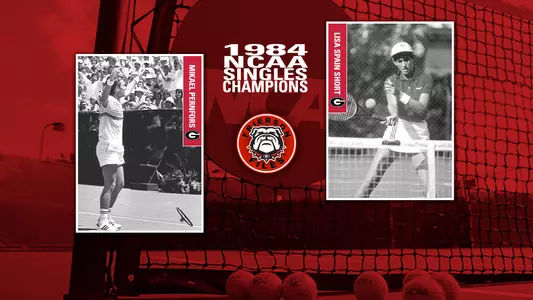
Two Wins For The Ages
May 23, 2019 | Men's Tennis, Women's Tennis, The Frierson Files
By John Frierson
Staff Writer
As she remembers it, Lisa Spain Short made two phone calls after the biggest win of her life. First, the 1984 NCAA women's singles champion called home, from UCLA's Los Angeles Tennis Center, soon to host the tennis at the 1984 Summer Olympics, to Moultrie, Ga., where her parents, Hank and Jean, were waiting by the phone.
The Spains had one phone, on a wall in the hallway. Those of a certain age remember that wall phone well, the one with the really long cord that stretched about 20 feet so you could have a little privacy.
"My parents had all of their church friends over and were just sitting around drinking coffee and waiting on the phone to ring," Short said recently.
Short was calling from L.A. ("It was a long way from Moultrie," she said) on May 20, 1984 — 35 years ago this week — where that morning she had just won not only the match and tournament of her life but by far the most significant match and tournament in the history of Georgia women's tennis.
"That was kind of the one great thing that the women's tennis program had done up to that point," said longtime women's coach Jeff Wallace, who took over the program in 1986. "I remember early on recruiting, in my first year and second year, always talking about, hey, we've had an NCAA singles champion. I think that gave the program some credibility early on."
With no live television coverage of the NCAA women's singles championship match, and this was more than a decade before most of us had heard of the internet, all the Spains and their friends could do was wait for news of their daughter's final against Lisa Gates of mighty Stanford.
Finally, in the early afternoon in Moultrie, the phone rang. Spain had completed a great career (multiple All-American honors and a 123-21 singles record) and spectacular senior season (39-3) by winning the program's first NCAA title, beating Gates in a tough final, 7-5, 3-6, 6-3.
"I think my mom and dad were fighting over the phone," Short said, laughing. "I remember there was a lot of screaming and 'Hallelujah, praise the Lord!'"
Short's second phone call from Los Angeles that day was to the tournament headquarters at Henry Feild Stadium, where another NCAA singles final was happening. Short was looking for legendary Georgia men's tennis coach Dan Magill, with whom she was very close. It wasn't easy to get ahold of Magill because right around the time Short called, Georgia's Mikael Pernfors was winning the NCAA men's singles title on the center court that now bears his name.
It was one of the greatest days in Georgia athletics history, May 20, 1984, when two NCAA singles championships were won by Bulldogs — the first for both the men's and women's programs that have since gone on to produce multiple team and individual champions and become two of the most successful programs in the sport.
Short, the small-town girl from Moultrie that went to Hollywood to win a national championship, and Pernfors, the cool Swede who came to Athens by way of Seminole (Fla.) Junior College to become one of the greatest collegiate players ever.
After winning the singles title in 1984, Pernfors returned for his senior season and helped lead the Bulldogs to the 1985 NCAA team championship, the first in program history, before becoming the first man in two decades to win back to back NCAA singles titles, beating teammate George Bezecny in the final.
"Winning the NCAAs twice, of course, was big," Pernfors said recently, "and winning the first one was bigger because I didn't know I could do that."
Magill signed Pernfors "sight unseen," the Hall of Fame coach wrote in his book "Match Pointers." Friends he trusted had told him that Pernfors, who didn't lose a match in two years on the junior college level, could help the Bulldogs.
"The very first time I saw Mikael Pernfors hit a tennis ball I knew Georgia had a genuine 'blue chipper,'" Magill wrote.
After Georgia's first preseason workout, Magill wrote, he told his then-assistant coach, and now a coaching legend in his own right, Manuel Diaz, "This boy has the ability to be our No. 1 player."
After Georgia's second practice, Magill wrote, he told one of the program's most loyal supporters, former English department head Dr. Robert West: "Pernfors is good enough to win the NCAAs," followed by the quip, "He's caught on to my coaching faster than anybody I've ever had."
Allen Miller, like Pernfors and Magill a member of the ITA Men's Tennis Hall of Fame, had a front-row seat to both Pernfors' and Short's great Georgia careers. Miller, a junior in 1984, had played No. 1 singles for Georgia the year before and won an NCAA doubles title — the first NCAA title of any kind in tennis at Georgia — with Ola Malmqvist.
In the first fall tournament, at Clemson, Pernfors beat Miller in the final. Pernfors then won the big fall tournament in Athens, the Southern Collegiates.
"It wasn't like he brought his game up for those tournaments — we knew, we knew," Miller said, laughing. He knew his days at the No. 1 spot were behind him.
Miller said he first started seeing Short at junior tournaments, including the old Crackerland tournament Magill hosted at Georgia, before they were teenagers. Her forehand, with the big looping swing, he dubbed "the Wheel of Fortune."
"Back then a lot of girls just took the racket straight back, a la Chris Evert and Jimmy Connors, but she had the big loop and it was fun to watch her play," said Miller, the longtime tennis director at the Athens Country Club. "We'd say, let's go watch the Wheel of Fortune just to see her."
Greg McGarity has a long list of accomplishments in his Georgia career. Back in the early 1980s, the J. Reid Parker Director of Athletics was a young women's tennis coach. He will tell you that his greatest achievement as a coach — he had three winning seasons in his four years on the job (1978-81) — was signing Short.
"Oh, yeah," he said. "Coaches never bat a thousand but every now and then you make a really good decision that turns into obviously one of the greatest players in Georgia women's tennis history."
It helped, he admitted, that his wife, Sheryl, was from Moultrie and knew the Spain family, and that Herbert Short, Lisa's childhood sweetheart and now longtime husband, was already in school at Georgia. It also helped that Coach Magill, who was good friends with Lisa's uncle, Frank Spain, was a big fan and was eager to see her play for the Bulldogs.
"She loved the University of Georgia, she loved being around Dan Magill and obviously her relationships with people who were all red and black certainly helped guide her to Athens," McGarity said. "It was a great date when she signed with the University of Georgia because we knew we had the best player in the state and one of the top players in the country."
Short went 56-1 in high school before coming to Georgia. Pernfors had gone 34-0 at Seminole as a sophomore and during his first fall as a Bulldog, he won 22 of 23 matches.
"I knew I was a good player at a junior college level, but I really had no idea or any expectations about what I could do against a totally new level of player," Pernfors said.
Clearly, the man could play.
"His forehand was a heavyweight punch," Diaz said, adding that Pernfors also thrived in the big moments. "He loved competition and more than anything his best tennis came in the biggest situations. ... He ate it up with a spoon."
Both Short and Pernfors could be described as late bloomers, their games really taking off when they got to college. By the time the 1984 NCAAs came along, they were in full bloom. Pernfors was the No. 4 seed in the men's singles tournament and Short the No. 5 seed in the women's.
Both were playing excellent tennis heading into the tournament, Both were tested early, rallying to win in three sets in the opening round.
Short faced a Swedish player from Northeast Louisiana, Maria Linstrom, the one player she'd told Georgia coach Cissie Donigan that she didn't want to play. Short had played Linstrom earlier in the spring and came away very impressed.
"She gave me a dogfight," Short said, adding, "I squeaked out a win and I remember telling my coach, Cissie, that I know I'm peaking and that this is just meant to be, but there's just one person I do not want to play. And that's who I had to play in the first round."
Linstrom took the first set 6-2 and was up at least one break of serve in the second. Distracted by construction work going on around the court at the tennis center as Olympic preparations continued and frustrated by Linstrom's play, Short came close to bowing out in the first round.
"I'm down something like 6-2, 4-1, and I'm like, wait a minute, this isn't how this is supposed to turn out," she said. The Bulldog turned it around, rallying for a 2-6, 6-4, 6-2 victory.
In the semifinals, Spain dropped the opening set to Gretchen Rush of Trinity and fought off several match points before winning the second set tiebreaker, 12-10. She then took the third set 6-3, earning a spot in the final against Gates.
Short figured that since Gates played for Stanford, another California school, that the crowd on hand at UCLA would be on Gates' side. Short didn't know at the time that UCLA fans loathe Stanford the same way they loathe USC. And loathe might be a generous assessment of their feelings.
"Well, everybody in the stadium that wasn't a Stanford fan was cheering for me," she said, laughing. "I milked that for everything it was worth and got the crowd behind me."
The crowd was behind her and it was treated to a great final, with Short coming out on top, 7-5, 3-6, 6-3.
"I remember match point, I had the Wheel of Fortune and I ran around my backhand on a second serve and hit a winner. And then that was it," said Spain, who played professionally for several years before settling down in Atlanta, raising three children and teaching loads of tennis.
Like everyone in her era, Short grew up playing with a small wooden racket. By the time she was a senior and one of the top players in the country, she was using a Prince Woodie. It was not used or beloved by many, nor was it around long, but Short made it work for her. And her NCAA title may be the greatest championship ever won with a Woodie.
"Coach Magill had it hanging over in the Hall of Fame for all those years," she said.
As the successor to Magill as curator of the Hall of Fame, I was happy to inform Short, who used to babysit my brothers and me, that her Woodie still hangs in the Georgia men's and women's history section of the Hall of Fame to this day, right beside a big photo of her holding her NCAA trophy.
"That makes me so happy," she said.
Also hanging in the Hall of Fame are both of the rackets Pernfors used to win his NCAA singles titles, including the Wilson Sting he used in 1984. Short used an oversized wooden racket and Pernfors a mid-sized graphite one — quite the contrast, but whatever works. And boy could Pernfors make that racket work.
"He was one of the most creative players I've ever seen," Diaz said. "His variety and pinpoint accuracy and his ability to move on the court were second to none."
All Pernfors did during the 1984 NCAA Championships was win all 10 singles matches he played: four in the team event and six in the singles tournament. He survived a three-setter against Mark Styslinger of SMU in the first round, a three-setter against UCLA's Jeff Klaparda in the third round, and in the semifinals, against No. 2-seeded Jonny Levine of Texas, Pernfors was in deep trouble before escaping.
Levin took the first set 6-1 and was up at least one break of serve in the second. And like Short across the country when she was in trouble, Pernfors rallied, prevailing 1-6, 7-6 (7-2), 6-2. Pernfors said he didn't remember that much about the tournament before the Levine match, but he remembered how important the thousands of Georgia fans in the grandstand were that day.
"I think if I would have played Levine anywhere else, I think I would have possibly lost that match," he said.
Waiting in the final was a familiar face, Clemson's Lawson Duncan, who had beaten Pernfors a few weeks before. There was no threat of that happening this time — Pernfors, playing in front of another packed crowd, dominated, winning 6-1, 6-4.
"He was a big-moment player and he just loved the limelight," Diaz said of Pernfors, who repeated as the singles champion in 1985 and almost exactly a year after that reached the finals of the 1986 French Open, falling to Ivan Lendl.
Short and Pernfors, two great champions, two great championships, earned on one amazing day for Georgia tennis.
John Frierson is the staff writer for the UGA Athletic Association and curator of the ITA Men's Tennis Hall of Fame. You can find his work at: Frierson Files. He's also on Twitter: @FriersonFiles and @ITAHallofFame.