
University of Georgia Athletics
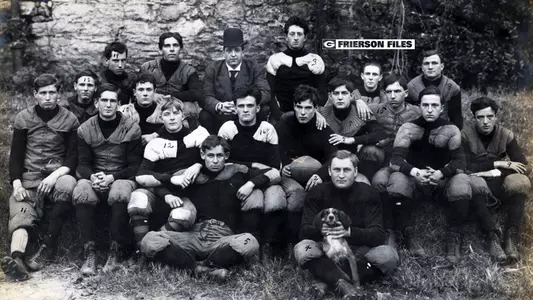
Early Years “Covered” In Exhibit
August 31, 2017 | Football, The Frierson Files
By John Frierson
UGAAA Staff Writer
The Georgia football players that will take the field at Sanford Stadium in Saturday's season opener against Appalachian State — all muscles and muscle memory developed from years and years of training — bear little resemblance to the original 11 players that made up the school's first team, 125 years ago.
"We were just a robust bunch of country boys, who knew nothing whatever of football or how it should be played," one of those original 11, George Shackelford, said in John F. Stegeman's book, "The Ghosts of Herty Field," about the early days of Georgia football.
The game is a way of life now, for players, coaches and fans alike, but when it first arrived in Athens, introduced by Georgia professor Dr. Charles Herty, it was mostly unknown, and much more like its forebear rugby than the ultra-specialized, ultra-technical modern game.
As part of the 125th anniversary of the start of Georgia's football program — which played its first game on Jan. 30, 1892, shutting out Mercer 50-0 — the Hargrett Library has put together an exhibit, "Covered With Glory: Football at UGA, 1892-1917." The exhibit is on display in the rotunda of the Russell Special Collections Library and will run through Dec. 22.
Assembled by curator Jason Hasty, Hargrett's athletics history specialist, the exhibit features rare photos, memorabilia and other items from the first 25 seasons of Georgia football. The exhibit is free and open to the public.
"I do months of background research before we even get to an exhibit," Hasty said. "I went through, starting at the beginning of this year, and read as many books as I could find on football in that era — not just Georgia football but any football, to get a sense of what it was like at the time, because it was such a different game back then, so much closer to rugby."
The best way to take in the exhibit is with a Hasty-led tour, which will take place Friday at 3 p.m., and every Friday afternoon before home games during the season. He'll talk about those early years, including the early mascots, and recount the ups and downs of the program.
After 25 seasons of Georgia football, before the two-year stoppage during World War I, the program had an overall record of 83-63-15. Most seasons consisted of between six and eight games, against a lot of teams the Bulldogs are still playing today, like Auburn (first meeting in 1892), Georgia Tech and Vanderbilt (1893), South Carolina (1894) and Tennessee (1899).
It was Dr. Charles Herty that brought the game to Athens and started the team, but he only coached the inaugural season, in 1892, when Georgia played two games, beating Mercer 50-0 to begin the program and then losing 10-0 to Auburn.
In the inaugural game, more a spectacle than a sporting event for the large crowd that gathered — historian and author Loran Smith says the first game is also the program's "first tailgate party" — Georgia scored on its first play from scrimmage, a long run by Herty's cousin, halfback Frank "Si" Herty. Later, Shackelford picked up a Mercer ball-carrier and ran with him on his shoulder into Mercer's end zone for a safety.
Indeed, it was a different game then. The many photos in the "Covered With Glory) exhibit just how different, from the look of the players and the field to most everything else.
"It's interesting to me because in a large way this is kind of the forgotten time in Georgia football — it's just so long ago and people don't think about it much," Hasty said.
Before Alex Cunningham coached his first game for Georgia, in 1910, the team had 13 coaches in 18 years, and no coach held the job for more than two seasons. Cunningham produced the first sustained run of success, going 39-16-6 during the seven seasons before play stopped for the war.
Part of the exhibit includes the story of Richard Albade Von Gammon, a Georgia player that in October 1897 suffered a fatal injury during a game against Virginia in Atlanta — he was carried off the field and died the next day. A month later, the state legislature voted to ban the game, but Von Gammon's mother wrote Gov. William Yates Atkinson, asking that the game her son loved be saved.
Among the lines in the letter: "Grant me the right to request that my boy's death not be used to defeat the most cherished object of his life." Her request was granted and the games continued.
Yes, the game was a lot different back that then, but clearly the spirit and passion for it has been there since the early years.
UGAAA Staff Writer
The Georgia football players that will take the field at Sanford Stadium in Saturday's season opener against Appalachian State — all muscles and muscle memory developed from years and years of training — bear little resemblance to the original 11 players that made up the school's first team, 125 years ago.
"We were just a robust bunch of country boys, who knew nothing whatever of football or how it should be played," one of those original 11, George Shackelford, said in John F. Stegeman's book, "The Ghosts of Herty Field," about the early days of Georgia football.
The game is a way of life now, for players, coaches and fans alike, but when it first arrived in Athens, introduced by Georgia professor Dr. Charles Herty, it was mostly unknown, and much more like its forebear rugby than the ultra-specialized, ultra-technical modern game.
As part of the 125th anniversary of the start of Georgia's football program — which played its first game on Jan. 30, 1892, shutting out Mercer 50-0 — the Hargrett Library has put together an exhibit, "Covered With Glory: Football at UGA, 1892-1917." The exhibit is on display in the rotunda of the Russell Special Collections Library and will run through Dec. 22.
Assembled by curator Jason Hasty, Hargrett's athletics history specialist, the exhibit features rare photos, memorabilia and other items from the first 25 seasons of Georgia football. The exhibit is free and open to the public.
"I do months of background research before we even get to an exhibit," Hasty said. "I went through, starting at the beginning of this year, and read as many books as I could find on football in that era — not just Georgia football but any football, to get a sense of what it was like at the time, because it was such a different game back then, so much closer to rugby."
The best way to take in the exhibit is with a Hasty-led tour, which will take place Friday at 3 p.m., and every Friday afternoon before home games during the season. He'll talk about those early years, including the early mascots, and recount the ups and downs of the program.
After 25 seasons of Georgia football, before the two-year stoppage during World War I, the program had an overall record of 83-63-15. Most seasons consisted of between six and eight games, against a lot of teams the Bulldogs are still playing today, like Auburn (first meeting in 1892), Georgia Tech and Vanderbilt (1893), South Carolina (1894) and Tennessee (1899).
It was Dr. Charles Herty that brought the game to Athens and started the team, but he only coached the inaugural season, in 1892, when Georgia played two games, beating Mercer 50-0 to begin the program and then losing 10-0 to Auburn.
In the inaugural game, more a spectacle than a sporting event for the large crowd that gathered — historian and author Loran Smith says the first game is also the program's "first tailgate party" — Georgia scored on its first play from scrimmage, a long run by Herty's cousin, halfback Frank "Si" Herty. Later, Shackelford picked up a Mercer ball-carrier and ran with him on his shoulder into Mercer's end zone for a safety.
Indeed, it was a different game then. The many photos in the "Covered With Glory) exhibit just how different, from the look of the players and the field to most everything else.
"It's interesting to me because in a large way this is kind of the forgotten time in Georgia football — it's just so long ago and people don't think about it much," Hasty said.
Before Alex Cunningham coached his first game for Georgia, in 1910, the team had 13 coaches in 18 years, and no coach held the job for more than two seasons. Cunningham produced the first sustained run of success, going 39-16-6 during the seven seasons before play stopped for the war.
Part of the exhibit includes the story of Richard Albade Von Gammon, a Georgia player that in October 1897 suffered a fatal injury during a game against Virginia in Atlanta — he was carried off the field and died the next day. A month later, the state legislature voted to ban the game, but Von Gammon's mother wrote Gov. William Yates Atkinson, asking that the game her son loved be saved.
Among the lines in the letter: "Grant me the right to request that my boy's death not be used to defeat the most cherished object of his life." Her request was granted and the games continued.
Yes, the game was a lot different back that then, but clearly the spirit and passion for it has been there since the early years.
John Frierson is the staff writer for the UGA Athletic Association and curator of the ITA Men's Tennis Hall of Fame. You can find his work at: Frierson Files. He's also on Twitter: @FriersonFiles and @ITAHallofFame.



Georgia Football 2026 GDay Spring Game - Postgame Player Sound
Saturday, April 18
Georgia Football 2026 G-Day TV Highlights
Saturday, April 18
2026 GDay Spring Game - Coach Smart Press Conference
Saturday, April 18
Georgia Football - Coach Smart Spring Practice Press Conference
Tuesday, April 07