
University of Georgia Athletics
September 05, 2026 | Football
By Kyle Tatelbaum
UGA Sports Communications
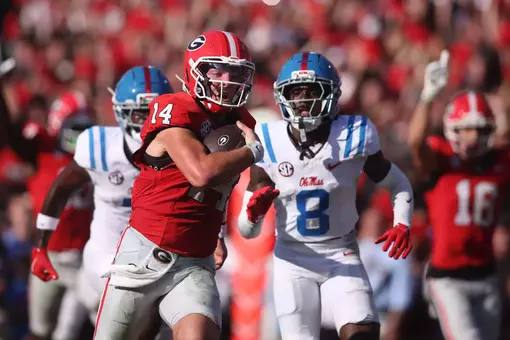
In college football, depth charts are supposed to impose order: first string, second string, roles carved in stone. On Saturday at Sanford Stadium, Georgia's wide receiver room refused that kind of neatness. Instead, it presented itself as something messier and more dangerous, a hydra, cutting off one head only to reveal three more waiting in the wings.
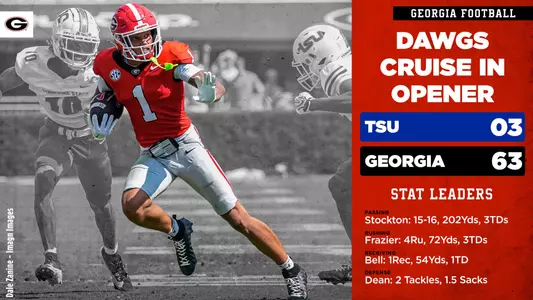
The Bulldogs' 63-3 season-opening rout of Tennessee State was a clinic in offensive abundance, but the most telling stat line belonged to the receivers. Georgia's receiving core collected 388 yards among 15 players and scored five touchdowns — all by different players. That is not just depth. That is a statement: there is no single player to game-plan against, no easy way to take the air out of this offense by shadowing one star.
Quarterback Gunner Stockton set the tone early, then ceded the day to the backups. He finished 15 of 16 for 202 yards and three touchdowns, with completions to nine different receivers and a flawless 261.7 passer rating. The distribution was deliberate and disorienting. A screen to Talyn Taylor. A shot to Isiah Canion. A tight-window strike to Elyiss Williams. Then, later, when Ryan Puglisi and Ryan Montgomery entered the game, the pattern held. Craig Dandridge Jr., Sacovie White-Helton, Jeremy Bell, all touching the ball, all threatening to turn a routine completion into a back-breaker.
This is what Kirby Smart's Georgia looks like in 2026: not a star-driven offense, but a system-driven one that elevates everyone. The Bulldogs finished with 660 yards of total offense, but the receiving numbers are the ones that will echo through SEC locker rooms. Fifteen players with a catch. Five different touchdown scorers in the passing game. A quarterback room that can rotate without the rhythm breaking.
Opposing coordinators will spend the week trying to find the weak link. Georgia's design ensures that if you take away the outside, the slot burns you. If you press the slot, the tight ends win in the middle. If you sell out to stop the pass, Nate Frazier, three touchdowns on four carries, reminds you that the run is still lethal. The point is not that any one receiver is unstoppable. The point is that all of them are dangerous enough to keep a defense honest, and together they form a constellation that is impossible to cover.
There is also a cultural element here. In past iterations, Georgia's offense could be described as "run-first with explosive plays sprinkled in." Saturday's performance suggested an evolution: an offense built on multiplicity, where the threat is not a single playmaker but the sheer number of viable options. That is a quarterback's dream and a defensive coordinator's nightmare. Stockton's near-perfect afternoon was less about heroics and more about execution, hitting the right read, trusting the route tree, and letting the system do the heavy lifting.
The heat index hovered around 100 degrees, but Georgia's passing attack never cooled. By halftime, the Bulldogs had already built a 35-3 lead, and yet the receivers kept producing. Puglisi's touchdown to Kaiden Prothro in the third quarter was the freshman's first career score. Montgomery's bomb to Bell was the third-string quarterback's first career touchdown pass and Bell's first career touchdown. Even in blowout mode, the depth chart kept churning, and the production kept coming.
This is the new reality for the SEC: Georgia is not just physically dominant; it is numerically overwhelming. The Bulldogs do not need a Heisman candidate at wide receiver to terrorize secondaries. They showed Saturday that they have 15 guys who can catch, five who can score, and a coaching staff that knows how to put them in positions to succeed.
Georgia's receiver room is not a hierarchy. It is a hydra. Cut off one option, and several more emerge, ready, willing and waiting to turn your coverage into a highlight.
UGA Sports Communications
In college football, depth charts are supposed to impose order: first string, second string, roles carved in stone. On Saturday at Sanford Stadium, Georgia's wide receiver room refused that kind of neatness. Instead, it presented itself as something messier and more dangerous, a hydra, cutting off one head only to reveal three more waiting in the wings.
The Bulldogs' 63-3 season-opening rout of Tennessee State was a clinic in offensive abundance, but the most telling stat line belonged to the receivers. Georgia's receiving core collected 388 yards among 15 players and scored five touchdowns — all by different players. That is not just depth. That is a statement: there is no single player to game-plan against, no easy way to take the air out of this offense by shadowing one star.
Quarterback Gunner Stockton set the tone early, then ceded the day to the backups. He finished 15 of 16 for 202 yards and three touchdowns, with completions to nine different receivers and a flawless 261.7 passer rating. The distribution was deliberate and disorienting. A screen to Talyn Taylor. A shot to Isiah Canion. A tight-window strike to Elyiss Williams. Then, later, when Ryan Puglisi and Ryan Montgomery entered the game, the pattern held. Craig Dandridge Jr., Sacovie White-Helton, Jeremy Bell, all touching the ball, all threatening to turn a routine completion into a back-breaker.
This is what Kirby Smart's Georgia looks like in 2026: not a star-driven offense, but a system-driven one that elevates everyone. The Bulldogs finished with 660 yards of total offense, but the receiving numbers are the ones that will echo through SEC locker rooms. Fifteen players with a catch. Five different touchdown scorers in the passing game. A quarterback room that can rotate without the rhythm breaking.
Opposing coordinators will spend the week trying to find the weak link. Georgia's design ensures that if you take away the outside, the slot burns you. If you press the slot, the tight ends win in the middle. If you sell out to stop the pass, Nate Frazier, three touchdowns on four carries, reminds you that the run is still lethal. The point is not that any one receiver is unstoppable. The point is that all of them are dangerous enough to keep a defense honest, and together they form a constellation that is impossible to cover.
There is also a cultural element here. In past iterations, Georgia's offense could be described as "run-first with explosive plays sprinkled in." Saturday's performance suggested an evolution: an offense built on multiplicity, where the threat is not a single playmaker but the sheer number of viable options. That is a quarterback's dream and a defensive coordinator's nightmare. Stockton's near-perfect afternoon was less about heroics and more about execution, hitting the right read, trusting the route tree, and letting the system do the heavy lifting.
The heat index hovered around 100 degrees, but Georgia's passing attack never cooled. By halftime, the Bulldogs had already built a 35-3 lead, and yet the receivers kept producing. Puglisi's touchdown to Kaiden Prothro in the third quarter was the freshman's first career score. Montgomery's bomb to Bell was the third-string quarterback's first career touchdown pass and Bell's first career touchdown. Even in blowout mode, the depth chart kept churning, and the production kept coming.
This is the new reality for the SEC: Georgia is not just physically dominant; it is numerically overwhelming. The Bulldogs do not need a Heisman candidate at wide receiver to terrorize secondaries. They showed Saturday that they have 15 guys who can catch, five who can score, and a coaching staff that knows how to put them in positions to succeed.
Georgia's receiver room is not a hierarchy. It is a hydra. Cut off one option, and several more emerge, ready, willing and waiting to turn your coverage into a highlight.
Players Mentioned

WR
/ Football
WR
/ Football
WR
/ Football
RB
/ Football
QB
/ Football
TE
/ Football
QB
/ Football
QB
/ Football
WR
/ Football
WR
/ Football
TE
/ FootballTuesday, October 27
Tuesday, October 27
Monday, October 26
Monday, October 26