
University of Georgia Athletics
Sugar Bowl Coaches Give Final Pregame Comments During Press Conference
December 31, 2025 | Football
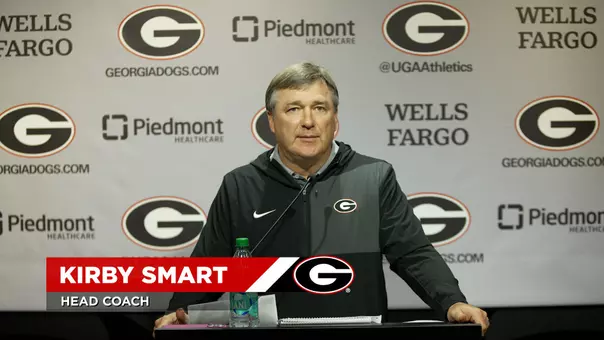
COACH SMART: I'll just open with thanking a lot of people. Jeff Hundley, the Sugar Bowl CEO, he's one of the best in the business. He's a UGA guy, worked at UGA for a while. I have a lot of appreciation for Jeff and his staff and the tremendous job they've done. It's certainly been a really hard transition on a lot of the people involved in the bowls, as we've gone to CFP.
This used to be a week-long event, and they had a lot of traditions that I've been a part of for many years. I think my wife and I were talking last night over dinner, this is the 10th or 11th Sugar Bowl I've been a part of. I was even a part of the Sugar Bowl in Atlanta, ironically enough during [Hurricane] Katrina, when Georgia played West Virginia. I've been a part of this group for a long time, and it's been amazing.
Jeff and his staff do a tremendous job. Also, Dottie Reese who was there to meet us right when we got off the plane. She does a tremendous job. She's the Sugar Bowl President and does an incredible job with the committee. The committee has been such great hosts to us at the hotel. I feel like I've known Dottie for years and for her to have her the opportunity to be the president. My wife was commenting last night on how awesome Dottie has been.
The presenting sponsor, Allstate, we thank them too. Thank you guys in the media for covering this. Just excited to get a chance to play an incredible team in Ole Miss. Pete [Golding] has done a fantastic job taking over for what was already rolling. It's going to be a great game. I think you're looking at two of the premier programs and two of the premier teams in college football. Two teams that earned their right to this game. Excited to get these kids out there and go let them play. Thank you.
COACH GOLDING: Obviously Kirby [Smart] thanked everything for both of us. Appreciate that, Coach.
COACH SMART: I did that for you.
COACH GOLDING: Appreciate that. I needed that. Super excited, like we talked about yesterday. An opportunity, obviously, to come back to where I'm from. Just like Coach Smart having an opportunity at Alabama to play in a bunch of Sugar Bowls and the job that you guys have always done and will always do. This environment and this venue of playing in the Dome for the players around our fan base that's very close, has been really exciting.
Huge opportunity in front of us. We know the knowledge. Georgia and Coach Smart are the premier program in college football. They've done that on a consistent basis, and that's where we're trying to get Ole Miss. We're really excited about the opportunity.
Q. This is for Kirby. You guys rank first in the country in fourth down conversion rate and second in red zone touchdown percentage. Why do you think you guys are so successful in those two particular areas?
COACH SMART: Well, we work at them. But that doesn't always have something to do with that. Those stats can be very misleading. Especially the fourth down one, because what fourth downs are you going for? Is it fourth and inches, fourth and one, or you're behind the game so you're going for fourth and 8, fourth and 7? Teams that win games usually have a pretty good fourth-down rate. They're not going for it all the time on fourth.
The LSU team in whatever year it was, with Joe Burrow and them, they didn't have any fourth downs. They didn't have third downs either. Nobody stopped them before they got to third or fourth. That can be a little mispleading.
I think the red zone percentage has a lot to do with being able to run the ball. You run out of field space out there and you have to find creative ways to score in the red zone. Our offense has been efficient in the red zone. We don't look at it as just field goals. We look at it as opportunities to score touchdowns. But it's a big part in games. It's usually a four-point play and we've been good at those.
Q. Pete, how has this transition from defensive coordinating to becoming a head coach, did you anticipate this? Is this something that you aspired for throughout your career and you knew it would come, so you've been you prepared for it? Or has this been learning on the fly?
COACH GOLDING: It's nothing that I grew up saying, hey, I want to be the head coach one day. I think in coaching, I've always been -- I am where my feet are. I'm going to do my job really well, whatever that job description is and try to do that to the best of my ability and affect the people around me. What opportunities that create, we'll address then.
I've been pretty adamant for a long time. I think this guy to my left kind of set it for me. Outside looking in, and being a defensive coordinator, and how he did it and how successful he was, and to be able to stay at one place for an extremely long period of time and be very successful and hand-select the one that he wanted, that was the goal of mine once I watched him do that.
I was not in a rush to become a head coach. CAA will tell you, I said: Don't contact anybody, I don't want a head coaching job. Once I left Alabama to come to Ole Miss, I wasn't leaving Oxford. I didn't want to be the head coach at Ole Miss. I wanted to be the defensive coordinator at Ole Miss. And that's the same thing that I told Kiff (Lane Kiffin).
When this opportunity presented itself, it's nothing that I've been preparing for. You prepare for it every year, because head coaches, like Coach Smart and Coach Saban and Coach Kiffin and all the guys I've been under, prepare you for these moments. They involve you in meetings of why we do certain things, and you're involved from a recruiting component and everything else.
Yes, I've all had two notebooks everywhere I've been, because of and in spite of. I think that's everywhere. You win because of a lot of things and you win in spite of a lot of things in certain places.
It's always keeping those, hey, if I ever got my opportunity, what would I continue to do that we've done that's been really effective? What would I eliminate that I don't think affects winning or losing?
This one is a little different from the timing of it. So, like Coach Smart already said, this thing is already rolling. It wasn't like we're taking over and we're starting fresh. At that point, we were 11-1. Everything was headed in the right direction. We've got really good players and good systems that have been in place. We've got a good staff. At that point, it was just trying to keep it together and get back to the routine as fast as possible and get back to ball.
It wasn't about changing everything. It wasn't about my opinion at that point. If anything has been changed since then, it's been through the Players Council and it's been voted on by the players because it's their team. We've added a couple of things that we felt like helped us through them, and we took away a couple of things that don't affect winning or losing. But that wasn't my decision in the entirety. That was also the Players Council decision.
A lot of people have gotten us to this point. Most importantly, the players, and let's create good plans for them to put them in the best position to have success. Let's hold them accountable in the process and let's go have fun doing it. The timing of this one is not like taking the first job, like Coach Smart did and you're going in the offseason and developing your staff and hiring and the recruitment component and all that. This is what it's going to look like. All that's going to happen in 2026. We're not going to try to change everything then.
So, it's been very successful. Really appreciated being under Coach Kiffin. I learned a lot and he did a great job of getting us to this point.
Q. This is for both coaches. How big a factor do you think experience will play in a game like this? Obviously, last year, Kirby, your guys were here. They went through the process.
Pete, your team has not been through that experience. What factor do you think experience will play in a game like this?
COACH SMART: I think it's a good topic for you guys to talk about and debate about. But once the players get on the field, all of that goes away. None of that matters. We've been in rematches, big games.
When you play in the SEC, every week is a big game. When you go on the road in the SEC and play, it's an environment like no other. It can't be matched.
The gauntlet of what their team has gone through and what our team has gone through, this is another SEC battle. I don't think personally think you can draw much on -- the experiences you learned from last year are experiences like travel, extra day in the hotel, where you don't get those in the regular season.
But in these kind of matchups, it still boils down to players making plays and coaches putting them in positions to.
COACH GOLDING: I agree 100%. The big thing for us is always the focus on the preparation aspect of it. Like Coach Smart just said, coming down three days prior is different than a normal away game. But the way the playoff is set up now, going into the Egg Bowl, that was a playoff game for us. If we didn't win that game, you weren't going to be playing in this game and have that opportunity.
The way it's set up now, every game towards the end of this season is that mindset, what everybody is talking about, going 1-0. I think the mindset and the focus hasn't changed. Obviously, the travel preparation component of it and being here three days early and all that. The transfer portal has changed that, too, because you brought guys in from other programs that have played in the playoffs. They individually have some experience. Then you have coaches around you that have experience as well that help you prepare with that.
But at the end of the day, you've got to spot the ball. It's not going to be the call that wins the game. It's going to be the execution of the call and the communication of 11 guys being on the same page and playing extremely hard and contesting every play. It gets back to the players, no doubt.
Q. This is for Kirby. Ethan [Barbour] and Colbie [Young] were taken off the injury report last night. How crucial is it going to be to have them available again? How much do you think they're going get to see the field?
COACH SMART: They both practiced for a while now and they've both been working their way back.
They were both really critical parts early in the season for Ethan. Tight end is a position that we have pretty good depth at. Ethan is a very attentive, wise beyond his years -- I mean, he was at our practices last year for this game, and we already knew, wow, this guy is going to be able to pick things up quick.
He's smart, he's tough, he's physical. We're excited to have him back and hopefully he can help in some capacity.
But you can only get so many tight ends on the field in so many ways. We've got some guys playing well at those positions.
Colby has done a great job coming back. When it first came out, I didn't think he was going to be back before the end of the season, regardless of how far our season went. He sped that process up. He wants to play. It's important to him. He's missed time and he wants to get back out there and go compete. But we'll have to see how he looks game day and what he's able to do and how we can work him in.
Q. Kirby, this is for you. Is there such a thing as too much information for your players during the preparation process during a long delay between games? If so, how do you balance the nuggets you give them, as opposed to just letting theming play free?
COACH SMART: There probably is a line of too much information. To me, it's more how you present the information. I'm all about presentation and being teachers as coaches. You learn from other people's mistakes. We try to do a good job of mixing things up in bowl practices, and not just doing all information on our opponent.
We do information on games going on in the National Football League, games going on across the bowl season. What do you see? What's the trend? How are things looking? People don't tackle well in bowls. People maybe turn the ball over because they don't get hit as much in bowls.
We don't make it just about information directly involving us or directly involving Ole Miss. We just make it a teaching and learning experience as much as we can for the guys and don't try to overload them. We haven't prepared for Ole Miss This entire time. We didn't sit back and said: All right, let's go play Ole Miss. We worked on ourselves for a while, which most people do. We worked on both opponents for a while. Then we came and centered around Ole Miss once we knew that was the outcome of their game.
Q. Question for both coaches. We talk about this being the fourth time in history that two SEC teams have played together, Ole Miss Being in three of those going all the way back to the '60s. What does it mean for both of you all to have this experience as two powerhouses playing in this matchup and the history behind it?
COACH GOLDING: Honestly, I would rather not be playing an SEC team. No, I think the SEC, it just shows what this league is week in and week out, and you've got to be ready to roll. Obviously, being at a different venue and the Sugar Bowl and the experience for our players is awesome, but I would rather see other teams outside of our league once we get out of our league.
But it's always a great challenge. Once you get in the playoffs, you've got to beat the best team to get the last win anyway. I told our guys from the very beginning, there's going to be one team that's happy at the end of this once you make the playoffs. That's it. Whether it's D-II/1-AA, every playoff I've ever been in, there's one team that's happy at the end. And so we might as well play the best ones early.
To be in this venue, and got our ass whooped by them earlier in the year, and kind of go through, and hopefully play better and give ourselves a better chance. But to be here in the Sugar Bowl and play a premier program and a premier coach, we're super excited for.
COACH SMART: Yeah, I'm excited as well because you get an opportunity to play -- you don't worry about the motivation when you're playing another SEC opponent. Your team respects those teams, and it's already happened once in the playoffs last week. It's a statement to the conference. And you get an opportunity to go play somebody that maybe you know something more about. You certainly have a lot more common opponents when you play within the league in the playoffs.
Q. Kirby, you've obviously had a lot of great defensive assistant coaches that have gone on to great things. Last year, you shared the stage with another coach with a great defensive background. I was wondering if you could share with us what you think about the job that Pete's [Golding] done? What you've seen from him. You've prepared for his teams and played against him several times.
COACH SMART: Yeah, a lot of respect for what Pete's done. It's a little unique. I spent a lot of time on the defensive side for us, so I'm usually looking at other teams' offenses, which has not been Pete's forte, nor mine. So we don't spend a lot of time on that.
But when you're crossing over and you watch other people play, you're usually watching their defense to see what they did to stop somebody, or you're calling somebody on defense to say, Hey, what did y'all think about this guy or that guy? Through the years, he's done a tremendous job defensively. Got an opportunity now to kind of form and mold a program in his eyes and how he wants to do it. And he's been around some really good ones, I know that. And very different leaders in the guys he's been around.
So it allows you to grow when you're around different kind of leadership styles like he's been around.
Q. Pete, kind of following up on a previous question, now that it is your program, as you get into the program-building aspect of culture, player retention, the way you build your roster, is Georgia sort of the model that you want to try to kind of build around?
COACH GOLDING: Whatever you're in, you're looking at who does it the best and who's done it the best on a consistent basis. And there's no doubt these last several years it's been Georgia. That was the same thing for the Bama run with Coach Saban. Every offseason when you're at Bama, every coaching staff comes in, everybody wants to know what the hell you're doing different and all those types of things.
But I think at the end of it, it's recruiting really good players who have toughness and discipline in the program, surrounding yourself with really good people that are smarter than you, and staying on the cutting edge of things. I think you've got to recruit at a high level and got to be exciting to watch, and you've got to be physically smart and all those things.
But all those components, I think, are going to come. I think it's based on people, and number one right now, I think the stability within our program is extremely important. And I think that's a big reason why I'm in the chair that I'm in is how much can we retain, both from a player and coach standpoint, on two systems that have worked and had success in this league consistently the last three years.
That's our top priority is retain as many players and coaches to keep the systems the same for our players moving forward based on the success that we've had.
Q. This question is for Kirby. You've been in two places now where you guys have won a lot of titles. What are the challenges to sort of keep that edge year after year? When you've got a group like this that maybe didn't have as many contributors to your last title, what is your sense of how much these guys want their own?
COACH SMART: Yeah, the group last year wanted it. The senior class, you're always trying to win for that team. Each team has a different makeup, mentality. You grow and create an identity throughout the year of what that team is. And every year it's been different.
Our teams have changed. The two national championship teams that were back-to-back were very different. So there's a hunger there. There's a drive there. There's guys in the room that stand up and talk, and their first time with being with our team and really experiencing things was the TCU game out in California. And now they're at the end of their ride. For them, it's like I always thought that it would come easy, that it would just happen naturally, that it was a given that you would be there. Nothing is given.
You go completely undefeated the following year, lose one game and don't make a playoff. It wasn't the 12-team playoff format, so you don't even make it. Then the next year you make it and you get beat by a Notre Dame team.
So you don't control a lot of that. You control your preparation. You control your thoughts, habits and priorities. And we try to center our attention around that. I don't look at this team and say, Oh, well, they're a failure if they don't win a national title.
Championships are what we all want, trust me. We all want to get them. But it's the ride and the affecting young people's lives along the way that we really do this for. And that means a lot to me, especially as I get older and up in age is what kind of relationship do I have with those guys? Will they come back to the program years from now? Are they invested in that G on that helmet? And that matters a hell of a lot more to me that they feel like they're a part of something bigger than themselves.
Q. Kirby, you've been at Georgia ten years now. Every team is a little bit different in one way, shape or form. What's been unique about this team from the previous ones?
COACH SMART: They've had a great personality. I think I've said it over and over, but there were times in the past that we were a little bit older or we had a lot of guys that had been in the program for a fifth or sixth year. It was during the little COVID run there. There were times you felt like they didn't love the game. They didn't really want to be out there and practice like you really want.
And that hasn't been the case for this group. They've had a lot of energy. We're a little younger, and they want to be coached. They want to be coached hard. They like practicing hard. They get out there and do exactly what you demand of them each and every day.
They've seen some of the rewards from that, some of the physical toughness, some of the stop the run, run the ball. I mean, like they see the rewards from it, and they bought into that being an identity. And that's created a little bit different -- now, I don't know we're as talented as some of those other teams, just sheer draft pick, but that's not always what wins. At the end of the day, it's the cohesion of a team, a lot of role players that you have that really buy into doing things that helps you win.
Q. Coach Smart, last year, I know it was a small sample, but the teams that had byes kind of struggled last year. It will be interesting to see how that plays out this week with the teams that have byes for the next couple of days. Is there an advantage, in your opinion, to playing that first game? Or last year was an aberration? What are your thoughts on that?
COACH SMART: I think it's going to play out like you said.
It's concerning as a coach to have a long layoff. I always repeat this: In no sport anywhere do you go that long in a team sport without playing a game when you're in a rhythm of playing a game, right? They don't have March Madness and say: Let's sit out 30 days and then come back and play March Madness.
Baseball, they don't do that. They just don't do that in sports. You play, you have a rhythm, you get going. Ours is very unique in that regard in terms of the setup for the break.
That may change in the future, I don't know. But I know I talked to several coaches in the playoffs about that exact thing. And there are a lot of them that wished, that wanted an ability to play a game in between those two because you're going to find out more about your team. If you're not good enough to win that game, you're certainly not going to win the next two or three.
So it is what it is. Everybody tries to spin it as an advantage, whichever way they take it. And nobody really knows what the advantage is because you can lose a player, you can get somebody injured when you play those games.
But we've taken a different approach to it this year. We're going to see how it goes. I don't think the outcome of the game defines the approach. I think it's as simple as saying, well, it doesn't work if you don't play a game. Not necessarily true. How did you play in the game? What were the factors that contributed to winning or losing the game? We'll see that tomorrow night.
This used to be a week-long event, and they had a lot of traditions that I've been a part of for many years. I think my wife and I were talking last night over dinner, this is the 10th or 11th Sugar Bowl I've been a part of. I was even a part of the Sugar Bowl in Atlanta, ironically enough during [Hurricane] Katrina, when Georgia played West Virginia. I've been a part of this group for a long time, and it's been amazing.
Jeff and his staff do a tremendous job. Also, Dottie Reese who was there to meet us right when we got off the plane. She does a tremendous job. She's the Sugar Bowl President and does an incredible job with the committee. The committee has been such great hosts to us at the hotel. I feel like I've known Dottie for years and for her to have her the opportunity to be the president. My wife was commenting last night on how awesome Dottie has been.
The presenting sponsor, Allstate, we thank them too. Thank you guys in the media for covering this. Just excited to get a chance to play an incredible team in Ole Miss. Pete [Golding] has done a fantastic job taking over for what was already rolling. It's going to be a great game. I think you're looking at two of the premier programs and two of the premier teams in college football. Two teams that earned their right to this game. Excited to get these kids out there and go let them play. Thank you.
COACH GOLDING: Obviously Kirby [Smart] thanked everything for both of us. Appreciate that, Coach.
COACH SMART: I did that for you.
COACH GOLDING: Appreciate that. I needed that. Super excited, like we talked about yesterday. An opportunity, obviously, to come back to where I'm from. Just like Coach Smart having an opportunity at Alabama to play in a bunch of Sugar Bowls and the job that you guys have always done and will always do. This environment and this venue of playing in the Dome for the players around our fan base that's very close, has been really exciting.
Huge opportunity in front of us. We know the knowledge. Georgia and Coach Smart are the premier program in college football. They've done that on a consistent basis, and that's where we're trying to get Ole Miss. We're really excited about the opportunity.
Q. This is for Kirby. You guys rank first in the country in fourth down conversion rate and second in red zone touchdown percentage. Why do you think you guys are so successful in those two particular areas?
COACH SMART: Well, we work at them. But that doesn't always have something to do with that. Those stats can be very misleading. Especially the fourth down one, because what fourth downs are you going for? Is it fourth and inches, fourth and one, or you're behind the game so you're going for fourth and 8, fourth and 7? Teams that win games usually have a pretty good fourth-down rate. They're not going for it all the time on fourth.
The LSU team in whatever year it was, with Joe Burrow and them, they didn't have any fourth downs. They didn't have third downs either. Nobody stopped them before they got to third or fourth. That can be a little mispleading.
I think the red zone percentage has a lot to do with being able to run the ball. You run out of field space out there and you have to find creative ways to score in the red zone. Our offense has been efficient in the red zone. We don't look at it as just field goals. We look at it as opportunities to score touchdowns. But it's a big part in games. It's usually a four-point play and we've been good at those.
Q. Pete, how has this transition from defensive coordinating to becoming a head coach, did you anticipate this? Is this something that you aspired for throughout your career and you knew it would come, so you've been you prepared for it? Or has this been learning on the fly?
COACH GOLDING: It's nothing that I grew up saying, hey, I want to be the head coach one day. I think in coaching, I've always been -- I am where my feet are. I'm going to do my job really well, whatever that job description is and try to do that to the best of my ability and affect the people around me. What opportunities that create, we'll address then.
I've been pretty adamant for a long time. I think this guy to my left kind of set it for me. Outside looking in, and being a defensive coordinator, and how he did it and how successful he was, and to be able to stay at one place for an extremely long period of time and be very successful and hand-select the one that he wanted, that was the goal of mine once I watched him do that.
I was not in a rush to become a head coach. CAA will tell you, I said: Don't contact anybody, I don't want a head coaching job. Once I left Alabama to come to Ole Miss, I wasn't leaving Oxford. I didn't want to be the head coach at Ole Miss. I wanted to be the defensive coordinator at Ole Miss. And that's the same thing that I told Kiff (Lane Kiffin).
When this opportunity presented itself, it's nothing that I've been preparing for. You prepare for it every year, because head coaches, like Coach Smart and Coach Saban and Coach Kiffin and all the guys I've been under, prepare you for these moments. They involve you in meetings of why we do certain things, and you're involved from a recruiting component and everything else.
Yes, I've all had two notebooks everywhere I've been, because of and in spite of. I think that's everywhere. You win because of a lot of things and you win in spite of a lot of things in certain places.
It's always keeping those, hey, if I ever got my opportunity, what would I continue to do that we've done that's been really effective? What would I eliminate that I don't think affects winning or losing?
This one is a little different from the timing of it. So, like Coach Smart already said, this thing is already rolling. It wasn't like we're taking over and we're starting fresh. At that point, we were 11-1. Everything was headed in the right direction. We've got really good players and good systems that have been in place. We've got a good staff. At that point, it was just trying to keep it together and get back to the routine as fast as possible and get back to ball.
It wasn't about changing everything. It wasn't about my opinion at that point. If anything has been changed since then, it's been through the Players Council and it's been voted on by the players because it's their team. We've added a couple of things that we felt like helped us through them, and we took away a couple of things that don't affect winning or losing. But that wasn't my decision in the entirety. That was also the Players Council decision.
A lot of people have gotten us to this point. Most importantly, the players, and let's create good plans for them to put them in the best position to have success. Let's hold them accountable in the process and let's go have fun doing it. The timing of this one is not like taking the first job, like Coach Smart did and you're going in the offseason and developing your staff and hiring and the recruitment component and all that. This is what it's going to look like. All that's going to happen in 2026. We're not going to try to change everything then.
So, it's been very successful. Really appreciated being under Coach Kiffin. I learned a lot and he did a great job of getting us to this point.
Q. This is for both coaches. How big a factor do you think experience will play in a game like this? Obviously, last year, Kirby, your guys were here. They went through the process.
Pete, your team has not been through that experience. What factor do you think experience will play in a game like this?
COACH SMART: I think it's a good topic for you guys to talk about and debate about. But once the players get on the field, all of that goes away. None of that matters. We've been in rematches, big games.
When you play in the SEC, every week is a big game. When you go on the road in the SEC and play, it's an environment like no other. It can't be matched.
The gauntlet of what their team has gone through and what our team has gone through, this is another SEC battle. I don't think personally think you can draw much on -- the experiences you learned from last year are experiences like travel, extra day in the hotel, where you don't get those in the regular season.
But in these kind of matchups, it still boils down to players making plays and coaches putting them in positions to.
COACH GOLDING: I agree 100%. The big thing for us is always the focus on the preparation aspect of it. Like Coach Smart just said, coming down three days prior is different than a normal away game. But the way the playoff is set up now, going into the Egg Bowl, that was a playoff game for us. If we didn't win that game, you weren't going to be playing in this game and have that opportunity.
The way it's set up now, every game towards the end of this season is that mindset, what everybody is talking about, going 1-0. I think the mindset and the focus hasn't changed. Obviously, the travel preparation component of it and being here three days early and all that. The transfer portal has changed that, too, because you brought guys in from other programs that have played in the playoffs. They individually have some experience. Then you have coaches around you that have experience as well that help you prepare with that.
But at the end of the day, you've got to spot the ball. It's not going to be the call that wins the game. It's going to be the execution of the call and the communication of 11 guys being on the same page and playing extremely hard and contesting every play. It gets back to the players, no doubt.
Q. This is for Kirby. Ethan [Barbour] and Colbie [Young] were taken off the injury report last night. How crucial is it going to be to have them available again? How much do you think they're going get to see the field?
COACH SMART: They both practiced for a while now and they've both been working their way back.
They were both really critical parts early in the season for Ethan. Tight end is a position that we have pretty good depth at. Ethan is a very attentive, wise beyond his years -- I mean, he was at our practices last year for this game, and we already knew, wow, this guy is going to be able to pick things up quick.
He's smart, he's tough, he's physical. We're excited to have him back and hopefully he can help in some capacity.
But you can only get so many tight ends on the field in so many ways. We've got some guys playing well at those positions.
Colby has done a great job coming back. When it first came out, I didn't think he was going to be back before the end of the season, regardless of how far our season went. He sped that process up. He wants to play. It's important to him. He's missed time and he wants to get back out there and go compete. But we'll have to see how he looks game day and what he's able to do and how we can work him in.
Q. Kirby, this is for you. Is there such a thing as too much information for your players during the preparation process during a long delay between games? If so, how do you balance the nuggets you give them, as opposed to just letting theming play free?
COACH SMART: There probably is a line of too much information. To me, it's more how you present the information. I'm all about presentation and being teachers as coaches. You learn from other people's mistakes. We try to do a good job of mixing things up in bowl practices, and not just doing all information on our opponent.
We do information on games going on in the National Football League, games going on across the bowl season. What do you see? What's the trend? How are things looking? People don't tackle well in bowls. People maybe turn the ball over because they don't get hit as much in bowls.
We don't make it just about information directly involving us or directly involving Ole Miss. We just make it a teaching and learning experience as much as we can for the guys and don't try to overload them. We haven't prepared for Ole Miss This entire time. We didn't sit back and said: All right, let's go play Ole Miss. We worked on ourselves for a while, which most people do. We worked on both opponents for a while. Then we came and centered around Ole Miss once we knew that was the outcome of their game.
Q. Question for both coaches. We talk about this being the fourth time in history that two SEC teams have played together, Ole Miss Being in three of those going all the way back to the '60s. What does it mean for both of you all to have this experience as two powerhouses playing in this matchup and the history behind it?
COACH GOLDING: Honestly, I would rather not be playing an SEC team. No, I think the SEC, it just shows what this league is week in and week out, and you've got to be ready to roll. Obviously, being at a different venue and the Sugar Bowl and the experience for our players is awesome, but I would rather see other teams outside of our league once we get out of our league.
But it's always a great challenge. Once you get in the playoffs, you've got to beat the best team to get the last win anyway. I told our guys from the very beginning, there's going to be one team that's happy at the end of this once you make the playoffs. That's it. Whether it's D-II/1-AA, every playoff I've ever been in, there's one team that's happy at the end. And so we might as well play the best ones early.
To be in this venue, and got our ass whooped by them earlier in the year, and kind of go through, and hopefully play better and give ourselves a better chance. But to be here in the Sugar Bowl and play a premier program and a premier coach, we're super excited for.
COACH SMART: Yeah, I'm excited as well because you get an opportunity to play -- you don't worry about the motivation when you're playing another SEC opponent. Your team respects those teams, and it's already happened once in the playoffs last week. It's a statement to the conference. And you get an opportunity to go play somebody that maybe you know something more about. You certainly have a lot more common opponents when you play within the league in the playoffs.
Q. Kirby, you've obviously had a lot of great defensive assistant coaches that have gone on to great things. Last year, you shared the stage with another coach with a great defensive background. I was wondering if you could share with us what you think about the job that Pete's [Golding] done? What you've seen from him. You've prepared for his teams and played against him several times.
COACH SMART: Yeah, a lot of respect for what Pete's done. It's a little unique. I spent a lot of time on the defensive side for us, so I'm usually looking at other teams' offenses, which has not been Pete's forte, nor mine. So we don't spend a lot of time on that.
But when you're crossing over and you watch other people play, you're usually watching their defense to see what they did to stop somebody, or you're calling somebody on defense to say, Hey, what did y'all think about this guy or that guy? Through the years, he's done a tremendous job defensively. Got an opportunity now to kind of form and mold a program in his eyes and how he wants to do it. And he's been around some really good ones, I know that. And very different leaders in the guys he's been around.
So it allows you to grow when you're around different kind of leadership styles like he's been around.
Q. Pete, kind of following up on a previous question, now that it is your program, as you get into the program-building aspect of culture, player retention, the way you build your roster, is Georgia sort of the model that you want to try to kind of build around?
COACH GOLDING: Whatever you're in, you're looking at who does it the best and who's done it the best on a consistent basis. And there's no doubt these last several years it's been Georgia. That was the same thing for the Bama run with Coach Saban. Every offseason when you're at Bama, every coaching staff comes in, everybody wants to know what the hell you're doing different and all those types of things.
But I think at the end of it, it's recruiting really good players who have toughness and discipline in the program, surrounding yourself with really good people that are smarter than you, and staying on the cutting edge of things. I think you've got to recruit at a high level and got to be exciting to watch, and you've got to be physically smart and all those things.
But all those components, I think, are going to come. I think it's based on people, and number one right now, I think the stability within our program is extremely important. And I think that's a big reason why I'm in the chair that I'm in is how much can we retain, both from a player and coach standpoint, on two systems that have worked and had success in this league consistently the last three years.
That's our top priority is retain as many players and coaches to keep the systems the same for our players moving forward based on the success that we've had.
Q. This question is for Kirby. You've been in two places now where you guys have won a lot of titles. What are the challenges to sort of keep that edge year after year? When you've got a group like this that maybe didn't have as many contributors to your last title, what is your sense of how much these guys want their own?
COACH SMART: Yeah, the group last year wanted it. The senior class, you're always trying to win for that team. Each team has a different makeup, mentality. You grow and create an identity throughout the year of what that team is. And every year it's been different.
Our teams have changed. The two national championship teams that were back-to-back were very different. So there's a hunger there. There's a drive there. There's guys in the room that stand up and talk, and their first time with being with our team and really experiencing things was the TCU game out in California. And now they're at the end of their ride. For them, it's like I always thought that it would come easy, that it would just happen naturally, that it was a given that you would be there. Nothing is given.
You go completely undefeated the following year, lose one game and don't make a playoff. It wasn't the 12-team playoff format, so you don't even make it. Then the next year you make it and you get beat by a Notre Dame team.
So you don't control a lot of that. You control your preparation. You control your thoughts, habits and priorities. And we try to center our attention around that. I don't look at this team and say, Oh, well, they're a failure if they don't win a national title.
Championships are what we all want, trust me. We all want to get them. But it's the ride and the affecting young people's lives along the way that we really do this for. And that means a lot to me, especially as I get older and up in age is what kind of relationship do I have with those guys? Will they come back to the program years from now? Are they invested in that G on that helmet? And that matters a hell of a lot more to me that they feel like they're a part of something bigger than themselves.
Q. Kirby, you've been at Georgia ten years now. Every team is a little bit different in one way, shape or form. What's been unique about this team from the previous ones?
COACH SMART: They've had a great personality. I think I've said it over and over, but there were times in the past that we were a little bit older or we had a lot of guys that had been in the program for a fifth or sixth year. It was during the little COVID run there. There were times you felt like they didn't love the game. They didn't really want to be out there and practice like you really want.
And that hasn't been the case for this group. They've had a lot of energy. We're a little younger, and they want to be coached. They want to be coached hard. They like practicing hard. They get out there and do exactly what you demand of them each and every day.
They've seen some of the rewards from that, some of the physical toughness, some of the stop the run, run the ball. I mean, like they see the rewards from it, and they bought into that being an identity. And that's created a little bit different -- now, I don't know we're as talented as some of those other teams, just sheer draft pick, but that's not always what wins. At the end of the day, it's the cohesion of a team, a lot of role players that you have that really buy into doing things that helps you win.
Q. Coach Smart, last year, I know it was a small sample, but the teams that had byes kind of struggled last year. It will be interesting to see how that plays out this week with the teams that have byes for the next couple of days. Is there an advantage, in your opinion, to playing that first game? Or last year was an aberration? What are your thoughts on that?
COACH SMART: I think it's going to play out like you said.
It's concerning as a coach to have a long layoff. I always repeat this: In no sport anywhere do you go that long in a team sport without playing a game when you're in a rhythm of playing a game, right? They don't have March Madness and say: Let's sit out 30 days and then come back and play March Madness.
Baseball, they don't do that. They just don't do that in sports. You play, you have a rhythm, you get going. Ours is very unique in that regard in terms of the setup for the break.
That may change in the future, I don't know. But I know I talked to several coaches in the playoffs about that exact thing. And there are a lot of them that wished, that wanted an ability to play a game in between those two because you're going to find out more about your team. If you're not good enough to win that game, you're certainly not going to win the next two or three.
So it is what it is. Everybody tries to spin it as an advantage, whichever way they take it. And nobody really knows what the advantage is because you can lose a player, you can get somebody injured when you play those games.
But we've taken a different approach to it this year. We're going to see how it goes. I don't think the outcome of the game defines the approach. I think it's as simple as saying, well, it doesn't work if you don't play a game. Not necessarily true. How did you play in the game? What were the factors that contributed to winning or losing the game? We'll see that tomorrow night.
Georgia Football - Lawson Luckie Pre-Spring Practice Press Conference
Tuesday, March 17
Georgia Football - Raylen Wilson Pre-Spring Practice Press Conference
Tuesday, March 17
Georgia Football - Gunner Stockton Pre-Spring Practice Press Conference
Tuesday, March 17
Georgia Football - Coach Smart Pre-Spring Practice Press Conference
Tuesday, March 17