University of Georgia Athletics
‘We Felt Good About Our Chances’
March 07, 2023 | Men's Basketball, The Frierson Files
By John Frierson
Staff Writer
When the 1983 SEC men's basketball tournament began, the Georgia Bulldogs were the No. 6 seed. A solid enough squad, yes, but with a league record of 9-9, there wasn't much reason for anyone to think that an historic run through the conference tourney and well beyond was about to commence.
OK, that's not exactly true.
"We were 9-9, but we were right on the cusp of really becoming a very cohesive and solid team," said James Banks, then a 6-foot-6 junior forward. "We felt very confident going into the tournament, and we played that way each and every game."
"I don't think any of us had any doubts, because we were playing well," said Derrick Floyd, a 6-5 senior guard and captain that season. "Everybody had some nervousness, I guess, knowing that if you lose, you're out of it, but I think we felt good about our chances."
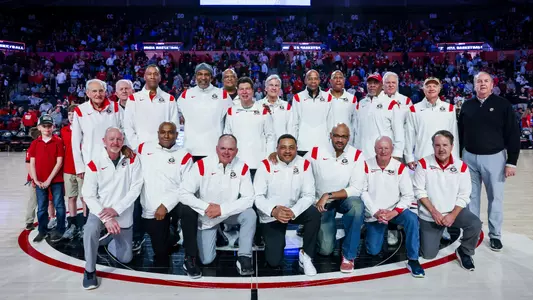
Earlier this season, 21 members (players, coaches and staff) of the 1983 team reunited at Stegeman to celebrate the 40th anniversary of their march to the Final Four. Wait, it's been 40 years? Can that be right?
"I don't know, ask these knees that question," Floyd said with a big laugh.
Georgia might have been playing well entering the tournament, but the results didn't necessarily show it. The Bulldogs lost their final two games before the SECs, at Kentucky and at Vanderbilt, and lost six of their final eight to end the regular season.
"Throughout that year, we had really a great bond going on," said Floyd, who is the Director of Operations for the Boys and Girls Club of Athens and is the official scorer at all home Georgia men's and women's basketball games.
"Us being friends and really bonding, playing well together, when you go to those tournaments, you really don't look at the seeds. You're kind of going in trying to look at the game in front of you."
At least externally, less may have been expected of the Bulldogs that season because Dominique Wilkins, already a program legend, had turned pro after the previous season. Wilkins, the "Human Highlight Film" who would go on to a Hall of Fame career in the NBA, was usually the focal point on the court. But playing without him the following season, other players elevated their games and flourished.
Georgia had four players, all high school Parade All-Americans, that averaged at least 10 points per game during the 1982-83 season: 6-foot-5 point guard Vern Fleming (16.9), 6-7 forward/center Terry Fair (13.6), Banks (14.0) and 6-1 guard Gerald Crosby (10.9).
"Our identity was, we wanted to defend, we enjoyed one another, and basically, we played with a little chip on our shoulder because while Dominique was an extraordinary teammate and player, some of us were high school All-Americans, as well," Banks said. "We wanted to prove, not only to others but to ourselves as well, that we were just as good of a team without Dominique."
The SEC that season was led by Kentucky, which went 13-5 in league play, but the next eight teams in the standings — it was a 10-team SEC at the time — were all bunched together. LSU and Ole Miss went 10-8, Georgia, Vanderbilt, Mississippi State and Tennessee finished 9-9, and Auburn and Alabama went 8-10. The only SEC team out of the mix that season was Florida at 5-13.
As has been the case entering so many SEC tournaments over the years, Kentucky, the only ranked program (No. 10) entering the tournament, was the team to beat. After that, it was anybody's tourney — even Georgia's.
"I thought we peaked at the right time, and it showed during the tournament," said Banks, who has taught and coached at Athens Academy for many years.
On the first day of the tournament, Alabama edged Auburn, 62-61, and Tennessee knocked off Florida, 78-62. In the quarterfinals, Georgia was matched up against third-seeded Ole Miss. The teams had split their regular-season games, with the road team winning by double digits each time.
In the SECs, Georgia took down the Rebels, 60-55, to advance to the semifinals. As it turned out, it was the closest game Georgia had in the tourney.
Elsewhere, Tennessee, the 7 seed, had upset No. 2-seeded LSU, 74-71, to advance to meet the Bulldogs in the semis. On the other side of the draw, Alabama upset top-seeded Kentucky, 69-64, and 5 seed Mississippi State routed 4 seed Vandy, 76-61. Based on seeding, all four quarterfinal winners were underdogs.
The tournament was now wide open.
In the first semifinal, Alabama beat Mississippi State in a nail-biter, 51-50. to advance to the title game as the 9 seed. Georgia's matchup with Tennessee was much less dramatic, with the Bulldogs rolling to a 79-60 win.
"The Tennessee game, we were just clicking," Floyd said. "Tennessee's always a tough game, but that game, we were at a whole other level. After the Ole Miss game, everything was just working."
Playing for the program's first SEC tournament title, Georgia came out fresh, confident and ready against a Crimson Tide team running on fumes after winning three games in three days by a combined seven points. The Bulldogs pulled away for good during what may be the finest second half of basketball in program history. Georgia hit 22 of 26 shots in the final 20 minutes and cruised to an 86-71 win.
"Offensively, we were just unstoppable," Floyd said.
"I knew we shot the lights out, but I had no idea we shot that well," Banks said. "We knew we were playing well, and we just sort of felt unbeatable. We weren't cocky about it, we just felt very confident. We defended really well and we scored a lot off of our defense."
Fleming was named MVP of the tournament, and the following year he was a first-round pick of the Indiana Pacers, with whom he spent the first 11 seasons of his NBA career. Fleming was also a member of the 1984 U.S. Olympic team that won the gold medal in Los Angeles, averaging 7.7 points, 2.7 assists and 2.7 rebounds a game.
Not only did the Bulldogs get to cut down the nets and hold up the SEC tournament trophy for the first time — it was Georgia's first conference title since winning the Southern Conference in 1932 — they also guaranteed themselves the program's first spot in the NCAA tournament. After receiving a No. 4 seed in the East Region, and a first-round bye, Georgia edged 5 seed VCU, 56-54, in the second round on a last-second tip-in. In the regional semifinal, the Bulldogs took down 1 seed St. John's, 70-67, behind 27 points and nine rebounds from 6-7 forward Terry Fair.
"Things really came together," Floyd said.
And perhaps most famously of all, Georgia bested Michael Jordan and No. 2-seeded North Carolina, 82-77, to reach the Final Four in Albuquerque, N.M. Banks led the Bulldogs with 20 points and was part of a stout defensive effort that caused a lot of problems for the mega-talented Tar Heels, who also featured future longtime NBA centers Sam Perkins and Brad Daugherty.
In North Carolina coach Dean Smith's previous seven trips to a regional final, according to a New York Times article from Georgia's win, the Tar Heels had won all seven games. Not this time, as the Bulldogs upset the defending national champions. "We really spoiled the party," said Fair, according to the Times report. Banks, who scored 20 against the Tar Heels, was named the Most Outstanding Player of the East Regional.
In the first, and still only, national semifinal in program history, Georgia, a team seemingly on one magical ride, ran up against a team in N.C. State that was in the midst its own memorable run. The Wolfpack beat the Bulldogs, 67-60, and then shocked the world with their 54-52 upset of a Houston team that featured Akeem (now Hakeem) Olajuwon and Clyde Drexler.
While the Georgia men were stringing all of those postseason wins together, winning seven straight before falling in the Final Four, the Georgia women were doing the same. Georgia was the first school in history to have their women's and men's teams advance to the Final Four in the same year. The two teams were close, often socializing or even playing together, and it was doubly exciting for both to have their counterparts also shining in March.
"We had a lot of respect for them. We used to go to practice early to watch them practice," Banks said. "There was a lot of respect and admiration for each other. It's always something special to be able to share that with another group."
Playing in the Midwest Regional as the No. 2 seed, the Georgia women beat North Carolina, 72-70, in the first round. They routed Indiana, 86-70, in the regional semifinal, and clinched their spot in the Final Four by knocking off 1 seed Tennessee, 67-63.
Like the Georgia men, the Lady Bulldogs fell in the national semis, losing 81-57 to Cheryl Miller and USC. Unlike the men, the Lady Bulldogs have been back to the Final Four four more times, and made 10 other trips to the Elite Eight. Banks is optimistic that both programs can get back there one day.
"We're even more proud of it now, because you realize how tough it was," Banks said of Georgia's SEC title and run to the Final Four. "We will hopefully have some more banners up there (in Stegeman) soon."
Three members of the Final Four team still rank in the top 13 all-time in career points: Fleming is fourth with 1,777, Fair is 10th (1,492) and Banks ranks 13th (1,430). Fair also ranks second in career rebounds (923) and Banks is 16th (654), while Fleming's 400 career assists are tied for sixth. Fleming (4th, 205) and Fair (6th, 194) about both in the top 10 all-time in steals, and Fair's 109 blocks rank 13th.
It was a special team that went on an extraordinary, history-making postseason run. The first, but hopefully not the last.
Assistant Sports Communications Director John Frierson is the staff writer for the UGA Athletic Association and curator of the ITA Men's Tennis Hall of Fame. You can find his work at: Frierson Files. He's also on Twitter: @FriersonFiles and @ITAHallofFame.