
August 10, 2020 | Football, General, Soccer, Volleyball, Cross Country, The Frierson Files
By John Frierson
Staff Writer
Ron Courson loves going to work every day. Georgia's Director of Sports Medicine is one of the very best in the business and approaches each day, each challenge, with his eyes and ears open, and with a passion for helping others.
Few people are better suited for their jobs than Courson, a Senior Associate Athletic Director, is for his. And few people are better suited to handle all of the uncertainties that have come with the coronavirus pandemic than Courson, who has been at Georgia since 1995. Along with his many years working with collegiate athletes, Courson worked as an athletic trainer at the 1988 and 1992 Summer Olympics and was the chief athletic trainer for track and field at the 1996 Games in Atlanta.
Courson is Georgia's representative on the SEC's Return to Activity and Medical Guidance Task Force, and during a Zoom call with the media on Friday, he said several times that Georgia has been "very fortunate" when it comes to health during the pandemic.
Georgia's student-athletes, he said, have been "very good" about following safety protocols and making good decisions. The reality of the situation, he said, is "we're in a pandemic. We can't prevent anything, the best we can do is mitigate." A father of four, Courson has a daughter that works with the Georgia football program and a son that plays high school football, so everything involving the pandemic is both a professional and very personal issue.
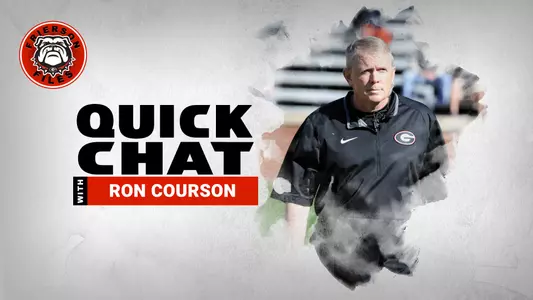
Earlier this summer, before Georgia's student-athletes returned to campus, Courson took some time for a Quick Chat. He talked about working harder than ever during the pandemic, finding his calling, his experiences at the Olympics, a trip to Mount Everest and much more. Here's some of what he had to say:
Frierson: I know a lot of people in the athletic department have had some downtime the past few months but I'm guessing you've been as busy as you've ever been.
Courson: I've been here the entire time, I never stopped. This has actually been one of the busiest times we've had, just trying to plan and prepare. I'm also on several task forces trying to come up with some plans, as well, so this has been a busy time.
Frierson: You're in a profession where you never stop learning, and you've always struck me as someone that's always very curious about things, so has this been a very educational time for you?
Courson: Without a doubt, and it's fluid. Things change every day. To give you an example, when we first started talked about this with our student-athletes (back in March), there were three symptoms: fever, shortness of breath and a cough. Now the symptom list has expanded dramatically and treatments have changed dramatically. For example, the first thing was ventilators, ventilators, and now (doctors) try really hard not to put them on ventilators because we've realized that's not the best treatment.
From a testing standpoint, we're learning a lot about the testing. Some of the tests that they're doing right now may be dramatically different in 30 days. It's been an evolving process and definitely eye-opening.
I've had the opportunity to be involved in a lot of different task forces, both conference-wise and nationally. For example, I'm with a cardiology group talking about the aspects of cardiology, and with an infectious-disease group talking about the disease's transmission and the best way to test.
You're looking at it through a lot of different lenses and the positive thing about that is that everybody wants the same result. I'm a parent, I have four children, and we have 550 or so parents that have trusted their child's healthcare to us, and we want to make sure we treat them just like we would our own children. Due diligence, we want to make sure we've looked at every aspect and every scenario so we can make sure we address their health and safety, but also from the parents' standpoint, have them feel comfortable about entrusting their child's healthcare with us again.
Frierson: This was supposed to be an Olympic year and I know you've had multiple Olympic experiences, so is there a memory that stands out from your time working at the different Summer Games?
Courson: They're all different. The first time you go to the Olympics, it's an awesome experience. The opening ceremony is still probably the most amazing memory I have. The first two I was really working more as an athletic trainer with the team and then the last one (in 1996) I was chief athletic trainer so I was in charge of developing all the protocols and emergency response plans across the board for the Olympic Games. I was a lot more involved in the planning for three years prior to that, so I had a lot more invested in that one.
Frierson: When you were a freshman at Samford, did you have any idea that this is what you wanted to do?
Courson: Absolutely not. It's funny, my dad was a Baptist minister and all of my brothers went into the ministry. I had one that became a missionary in the Far East for 25 years, but all three of my brothers became Baptist ministers.
I was fortunate, I played two sports at Samford, I ran track and played soccer. I wanted to be a coach and that was my plan, and my junior year I injured my knee and had a couple of surgeries. My team physician talked to me about changing my major to sports medicine and that's how I fell into it. I got interested in the rehab and I continued running track and playing soccer, but I changed my major and it was the best thing I ever did.
Frierson: I've talked to a lot of student-athletes over the years that because of a serious injury in high school or college decided that sports medicine was what they wanted to study and pursue professionally.
Courson: I agree. You know, I'm involved in physical therapy education and athletic training education and I would say probably at least half of our students, that's how they got into it — either they had an injury themselves or maybe they had a loved one that had one. Not that you have to have an injury to give you this but I think having that injury in college game me a different perspective.
I'd never been injured in my life and the only time I ever went into the training room was maybe to have my ankles taped or a blister fixed. I had an injury that required some surgeries with it and it gave me a different perspective. Sometimes when you're communicating with an athlete, having been down that path I think makes you a little more empathetic and understanding of what they're going through from a physical as well as a psychological standpoint.
Frierson: How would you rate yourself as an athlete back in your college days?
Courson: I was a much better student [laughs]. I really enjoyed it and I wouldn't trade it for anything, but I was probably a much better student than I was an athlete.
Frierson: Sports have taken you around the world so is there one place you would like to go back to one day?
Courson: I have been to some really interesting places and I've enjoyed every one of them. It was interesting, I went to Yugoslavia for the World University Games and that was actually right before the war broke out. One of the places I would like to go back to was not really for work but I went to Mount Everest base camp a couple of years ago and climbed there. I want to go back and do that again, that was just an awesome trip.
Frierson: What led you there and what was it like to be there?
Courson: I've always liked the outdoors and I do a lot of hiking. I've done some climbing in the past, I've climbed Mount Rainier a couple of times and climbed some 14,000-foot peaks in Colorado, and we had a professor here, Mike Ferrara, the chair of the athletic training education program, and Mike did some climbing as well. We got to talking and there was a group putting together a trip to Everest.
We were actually gone 20 days, which is the longest I've ever gone anywhere, and it was a great opportunity to visit a unique part of the world. We didn't summit, we went to base camp, and it was a great trip that I'd like to do again at some point.
Frierson: What is the best meal you've ever eaten? Is there one that stands out above the rest?
Courson: I would say anything with my family. I enjoy spending time with my family and any opportunity we have, whether it's a vacation or a trip or just at home, any meal I can have with my family is always something special.
Frierson: If you could be great at anything for a day, just to experience it, what would it be?
Courson: I would just say being the best at whatever I do. That's the challenge we all have, we want to be the very best at what we do, and this is a great example right now with the COVID thing. It's a new opportunity and we're learning, and we want to be the very best we can be at what we do because it affects our student-athletes.
I've been very blessed. We've got an awesome staff here and I wouldn't trade my staff and my team physicians for anything. And we've got great administrative support here, and that's what makes it fun. If you have a passion for what you do in your job and you enjoy the people you're around, and you're all working for a central theme or focus, it makes it fun. And I think we have that at Georgia.
We have some elite coaches and elite student-athletes, we've got a great administration and everybody's working together for a common goal. That makes it fun to be around.
(This Q&A was lightly edited for length and clarity.)
Assistant Sports Communications Director John Frierson is the staff writer for the UGA Athletic Association and curator of the ITA Men's Tennis Hall of Fame. You can find his work at: Frierson Files. He's also on Twitter: @FriersonFiles and @ITAHallofFame.


Georgia Football vs South Carolina Game Trailer
Friday, November 20
Georgia Football - Elijah Griffin Pre South Carolina Press Conference
Tuesday, November 17
Georgia Football - London Humphreys Pre South Carolina Press Conference
Tuesday, November 17
Kirby Smart All Access vs Missouri - 2026
Monday, November 16