
June 11, 2020 | Baseball, General, Swimming & Diving, The Frierson Files
By John Frierson
Staff Writer
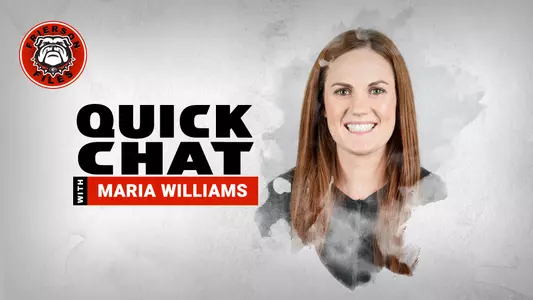
Maria Williams was a competitive swimmer through high school. In her role as one of Georgia athletics' nutritionists and dietitians, she knows well what those hard-working swimmers' bodies need to train and perform at a high level.
Williams is a Double Dawg, having earned her undergraduate and master's degrees at UGA. She knew that she wanted to do something related to food after college and it was as an undergrad that she discovered what registered dietitians do and how important and valuable their work can be. She currently works with Georgia's swimming and diving teams, baseball, men's tennis and equestrian.
During a recent Quick Chat, Williams talks about working at home during the coronavirus pandemic, getting into nutrition, what food she could eat every day and much more. Here's some of what he had to say:
Frierson: What has your work life been like the past couple of months?
Williams: Work has been very different. Being one of the Olympic-sport dietitians, most of my teams are in season in the spring, so all of that got uprooted. Luckily, we have still been able to, through Zoom meetings and phone calls, meet with a lot of the student-athletes. That's been a good opportunity and our focus has shifted — at the beginning of all of this it was, how do you get access to food and what does your grocery store look like? What are the shifts you need to make with your activity being down?
Now, I actually had a couple of baseball players reach out to me today, it's gearing back up. They're able to start exercising again and so they're starting to refocus on what they need to do in terms of recovery from working out and what they need to get in to be ready for when they come back.
The thing I haven't been doing a lot of, that was a huge part of my job, is the food-service side. The nutritionists now, we've been doing so much feeding in terms of catering meals and working with our training table and setting up snacks everywhere. That's been a huge adjustment, refocusing and shifting to education and teaching the student-athletes what they need to get in versus just supplying food every which way.
One of the things that's been a bright spot is teaching the student-athletes skills for being successful at feeding themselves throughout their life.
Frierson: Are you actually teaching them how to cook?
Williams: There has been a lot of that. We launched in the spring a student-athlete digital cookbook, which helps. We're telling them to look at certain YouTube videos or talking them through things. We actually did a social media cook-off among our staff, just to help get student-athletes talking about food. We did do virtual grocery lists and things like that — we're teaching them to cook and teaching them to grocery shop and put things together.
At school, I'm doing less of that because they're provided so much food that they're not really flexing those skills of shopping and cooking as much.
Frierson: Were you interested in nutrition at a young age or did this career come about because of something in particular?
Williams: Not from a very early age. I went to Georgia for undergrad and grad school and in college it kind of hit. It's interesting, I got more interested in food before I got interested in nutrition. I didn't even know anything about registered dietitians or that that was a job. I originally had a major in consumer foods because I was like a foodie and really liked to eat and cook, and thought that I could do something with that as a career.
I actually did do a lot of cooking in college and most people don't. The skill-set of cooking is not something that a lot of people go into college with, so it is a fun area to be able to teach that, for sure.
Frierson: What was the first thing you cooked really well?
Williams: I did homemade pizza and I think that's what I was proudest of. For some reason, I liked making dough [laughs] and it felt like a big accomplishment to be able to make your own pizza. That's something I would do for my friends, make the dough and they'd come over and have pizza.
Actually, that's been a nice thing for my family during this time too, we've gotten back mealtime. You're so busy, you're at work and different events and you lose that. I have a 6-month-old at home and so my husband and I are having more meals which has been really nice.
I'm hoping that some of our athletes are to get some of that at home, too. That's been a treat for me and hopefully that's something good that's come out of this for a lot of people.
Frierson: Other than working with the teams and student-athletes from afar and taking care of your 6-month-old, what else are you doing these days? Have you picked up any new hobbies?
Williams: We did start a garden at home, which was good. I used to grow a garden and it's been four or five years since I've done it, so that has been nice. Actually, my husband headed it up and we're doing an outdoor vegetable garden and herb garden, which has been really nice.
We have also walked every street around our neighborhood that we can think of [laughs]. We've definitely been doing a lot more of that which has been nice, too, just getting outside. We weren't walking the neighborhood at all and we had stopped doing the gardening, so those are two things that have started to take up more of my time now that I'm working the way I was. And our 6-month-old definitely takes up a lot of time [laughs].
We've met so many more of our neighbors during this than we ever had before because everybody's out in their yard or walking around and getting outside. I honestly have more of a sense of community for my neighborhood now than I did before this, even though we can't get really close and interact with people.
Frierson: I read that you were a competitive swimmer at one point, so what can you tell me about your days as an athlete?
Williams: It's been a long time and I retired after high school. My sister went on to swim in college, at Florida State, and really what it came down to is, I could have gone to another university and kept swimming. I'm from Georgia and I probably wasn't fast enough to swim for our team, but I could have gone to another school and swam for their school, but when it came down to it I just decided I'd rather be at UGA.
It was a good time for me to step away from the sport. That was hard for me, so I can't even imagine, when I think about our student-athletes that are transitioning away from sports after college, it's so much more of a part of their lives than it was for me — it can definitely be a huge transition.
When I started working at UGA, that was one sport I knew very well. I knew that when I was working with swimmers that I fully understood and knew the training cycle and what they were going through. There were other sports that I had such a learning curve on, like equestrian and even traditional sports, like in my first year working women's basketball. I wasn't coordinated so I never played basketball [laughs].
Frierson: What's something you could eat every day and never get tired of it?
Williams: Ooh, bread [laughs] — bread for sure. That would be the one food that I probably couldn't live without and that I could eat every day and not get sick of.
Frierson: A lot of people have become bread bakers during this shutdown, especially sourdough. Have you been baking bread as well?
Williams: I have not done sourdough but I did bake some different loaves of bread and I've done a lot of different baking — when I can acquire flour. It's so interesting, I did it a lot at the beginning and then you went through a period where it was really hard to find any flour.
Frierson: If you could be great at anything for a day, just to experience what it's like, what would it be?
Williams: It would probably be a sport. You know, I spend a lot of time up at a lake and I never learned how to water ski or do any of those water sports, and I feel like I'm getting to the age now where I'm too scared to try to learn [laughs] because I would just face-plant.
The few times I tried I could never get up and being an adult, I just overthink it. If I learned as a child I think I could have been good.
Frierson: I did water skiing once and just kept falling so I always preferred to hang out in the boat instead. I've also never been snow skiing. That's so intimidating to me at this point that I'm afraid to even try it.
Williams: Actually, now I'm debating between snow and water because that's the same thing — I'd love to do a ski trip but I can't ski [laughs] and I don't see myself learning.
(This Q&A was lightly edited for length and clarity.)
Assistant Sports Communications Director John Frierson is the staff writer for the UGA Athletic Association and curator of the ITA Men's Tennis Hall of Fame. You can find his work at: Frierson Files. He's also on Twitter: @FriersonFiles and @ITAHallofFame.



BMW AD Update with Josh Brooks and Randi Roelling
Thursday, April 30
BMW AD Update with Josh Brooks and Lily Smith
Thursday, April 16
HOPE Scholar of the Game - MBB vs. Alabama
Tuesday, March 03
HOPE Scholar of the Game - MBB vs. South Carolina
Saturday, February 28