
University of Georgia Athletics
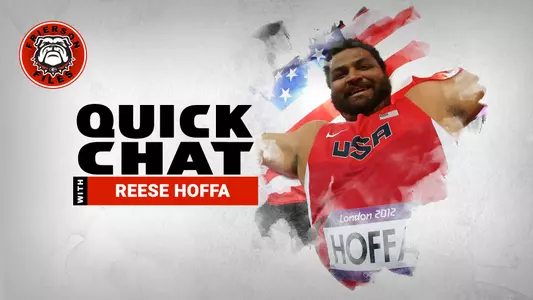
Quick Chat: Reese Hoffa
May 26, 2020 | Track & Field, The Frierson Files
By John Frierson
Staff Writer
When Reese Hoffa arrived at Georgia as a freshman thrower in 1997, he never imagined that he could one day have a lengthy professional career in the shot put. Even after four good years throwing for the Bulldogs, becoming a five-time All-American, Hoffa never imagined he'd one day earn the title world champion. And then earn it again the following year.
After competing in three Olympics (2004, 2008, 2012) — including earning a bronze medal in London in 2012 — and winning world championships in 2006 and '07, as well as finishing in the top three in the world for a staggering 10 consecutive years, Hoffa retired from competition in 2016. It was a 15-year career that had a bit of everything.
These days, amid the coronavirus pandemic shutdown, Hoffa, a Circle of Honor inductee, is at his home in Athens with his wife and 5-month-old daughter, Piper. When the world gets rolling again he will too, coaching throwers at his Hoffa Throws Academy and working as a massage therapist. During a recent Quick Chat, Hoffa talked about Olympic memories, sustained excellence and much more.
Here's some of what he had to say:
Frierson: What are you doing during this time when you can coach or do much of anything that you normally do?
Hoffa: I'm spending a lot of time with my daughter. She's five months old, so I look at it as a good time for me because I don't have to worry about work and all that — I just get to spend tons of time with her.
Frierson: This was supposed to be an Olympic year, so have any of the memories come flooding back for you?
Hoffa: I think when it comes around, for me, it brings back the memory of 2016 when I didn't make the team. I made my first try back in 2000 and I was just excited to make the (Olympic Trials) final, and then in 2004, '08 and '12, I made those teams, which were awesome.
I think about, what did I do wrong in '16 that kept me off the team? It's always an exciting time to think about the Olympic Games and all the preparation that I would normally put into trying to make those teams.
Frierson: Is there one of those Games that stands out the most? Obviously, you earned a bronze in 2012 and got to stand on the podium, but is that the first thing you think of when it comes to the Olympics?
Hoffa: I would think the 2008 Olympic Trials probably stood out the most to me, only because I went into those Olympics on a little bit of a hot streak. I'd won the World Indoor Championships in 2006, World Outdoor Championships in 2007 and then I won the 2008 Olympic Trials and threw really well. I was on cloud nine.
The Olympics didn't go exactly the way I wanted but I felt like I was coming into my own as a thrower at that time and was becoming one of the guys, one of the dominant throwers in the sport. That definitely stands out to me.
Frierson: You finished top three in the world for 10 straight years, which is an incredible achievement. Where does that rank among you many accomplishments?
Hoffa: I think of that as being kind of the Lou Gehrig award. You have to have a lot of longevity in the sport and you have to stay healthy for long periods of time. Obviously, luck kind of plays into that too, like I had some really tough years when I had to really compete well at the end of the year to sway the people that vote to put me in the top three. ... To me, that's huge. I feel like anybody can be good for one or two years, but it says something that year after year you're exceptional.
Frierson: When you were coming out of Evans, Ga., and Lakeside High School, could you have ever imagined that you'd have the professional career that you had? Not only have you achieved so much, but you've been able to travel the world doing what you love.
Hoffa: I would have never thought in a million years that I would have been a professional shot putter. I'm not going to say I fell into it because you have to earn your way into it, but when you make your first Olympic team, I was thinking that would be the only team I ever made. I was like, I may never make another Olympic team, I better just enjoy it.
To have the continued success, you start seeing a few things. I started throwing a little further, I started placing well against the top guys, who at that time were guys like John Godina, Adam Nelson, Christian Cantwell was coming on around that time also. I was like, there are already so many exceptional throwers around, where am I going to find my niche? And I started getting better and better, and then I'm like, maybe I can make it.
Each year I kept making more money and I could continue to be a professional thrower, and then all of a sudden, 15 years later, I'm retiring. I can't believe I did this for 15 years, it's crazy.
Frierson: "World champion" is one of the great titles that anyone can have, in any sport. What is it like to earn that and be able to have that on your resume?
Hoffa: It's extraordinary. When I won my first one, in Moscow, I was balling my eyes out on the plane home, because I'm like, I can't believe I did this. Everyone dreams about it, I'm going to be a world champion one day, but when you actually go out there and do it, you've achieved it and they're putting that gold medal around your neck, you're just like, oh, my gosh!
It blew me away. I feel like it was a decisive victory in a way, I went in there and was three or four feet better than the next guy, and there was no doubt that I was going to be the world champion at that moment. I definitely soaked it in when I won.
Frierson: Do you miss competing?
Hoffa: Absolutely. In my crazy mind I'm like, yeah, I could still compete. Then I go outside and I pick up a 16-pound ball, I still have a couple around my house, and then it's like, nope.
Frierson: What is the best meal you've ever eaten? Is there one that stands out above the rest?
Hoffa: My Oreo milkshake that I made in London (at the 2012 Olympics) was awesome. When you win a medal there's this whirlwind of responsibilities that come your way, so that you do all the interviews and then I went to sleep, so I barely had anything to eat.
The next day, I got to go to the Olympic Village and I took with me some regular Oreos to crush into a soft-serve vanilla ice cream at McDonald's. That next day at dinner I finally got to sit down and crush these Oreos up and put it in my ice cream to make a milkshake — and it was absolutely delicious.
My other answer is, I'm flying from the U.S. to Germany and I haven't eaten in something like eight hours. We land in Munich to make another connection to go somewhere else and I find this random place that has this steak schnitzel with potatoes and a yellow sauce, and it totally rocked my world. It was the greatest meal I ever had in Europe. I was so hungry and to get a meal that was filling and delicious as that was mind-blowing.
Frierson: As big a guy as you are, how hard were all of those flights? Most airplane seats aren't made for guys your size.
Hoffa: They're not. One time me and Adam (Nelson) were flying from London to Berlin and we get on this plane. It wasn't that full so there was plenty of space around and me and Adam were like, we're going to sit in the exit row. We're sitting there and they're doing the pre-checks and the stewardess comes up to me and says, um, you can't sit in the exit row because you are too big, no one would be able to exit the plane if you are sitting in the exit row.
So she kicked me out of the exit row and this is the first time this has ever happened to me. Adam is on the other side just dying, oh, my gosh, you're so fat they wouldn't let you sit in the exit row [laughs]. They moved to me to business class, but that was the first time I'd ever been in that situation.
Frierson: You're now running your throws academy and doing massage, so when did you know you wanted to get into coaching and how did the massage come about?
Hoffa: In 2012, when I won the bronze medal, I was in the process of beginning my exit strategy. I thought I was going to be a schoolteacher, to tell you the truth. I went to Oconee County High School and volunteered as an assistant coach on the football team so I could get an idea of what I'm going to get into once this is over. ... A few years pass and my wife's like, I don't think you should be a schoolteacher. Why not just do some coaching?
I started coaching a few athletes here and there and I'm like, this is kind of fun, and I just continued to coach. More and more people looked me up and I started coaching them. You can only coach a few hours a day and I knew I had to fill the rest of my day with something, so I decided to go to massage school. One of my good massage therapists around here, Suzanne Jones, basically was like, Reese, I think you would be a great massage therapist.
I like science and I kind of wanted to be in the medical field in some capacity, so I went to massage school. It's been about two years now and I greatly enjoy it. I work at Piedmont and I'm supposed to working with Georgia. I was going to do something with tennis and then the coronavirus hit. My goal is to get in with the university, tennis, golf, track, whoever needs help with massage. It's been great so far.
(This Q&A was lightly edited for length and clarity.)
Staff Writer
When Reese Hoffa arrived at Georgia as a freshman thrower in 1997, he never imagined that he could one day have a lengthy professional career in the shot put. Even after four good years throwing for the Bulldogs, becoming a five-time All-American, Hoffa never imagined he'd one day earn the title world champion. And then earn it again the following year.
After competing in three Olympics (2004, 2008, 2012) — including earning a bronze medal in London in 2012 — and winning world championships in 2006 and '07, as well as finishing in the top three in the world for a staggering 10 consecutive years, Hoffa retired from competition in 2016. It was a 15-year career that had a bit of everything.
These days, amid the coronavirus pandemic shutdown, Hoffa, a Circle of Honor inductee, is at his home in Athens with his wife and 5-month-old daughter, Piper. When the world gets rolling again he will too, coaching throwers at his Hoffa Throws Academy and working as a massage therapist. During a recent Quick Chat, Hoffa talked about Olympic memories, sustained excellence and much more.
Here's some of what he had to say:
Frierson: What are you doing during this time when you can coach or do much of anything that you normally do?
Hoffa: I'm spending a lot of time with my daughter. She's five months old, so I look at it as a good time for me because I don't have to worry about work and all that — I just get to spend tons of time with her.
Frierson: This was supposed to be an Olympic year, so have any of the memories come flooding back for you?
Hoffa: I think when it comes around, for me, it brings back the memory of 2016 when I didn't make the team. I made my first try back in 2000 and I was just excited to make the (Olympic Trials) final, and then in 2004, '08 and '12, I made those teams, which were awesome.
I think about, what did I do wrong in '16 that kept me off the team? It's always an exciting time to think about the Olympic Games and all the preparation that I would normally put into trying to make those teams.
Frierson: Is there one of those Games that stands out the most? Obviously, you earned a bronze in 2012 and got to stand on the podium, but is that the first thing you think of when it comes to the Olympics?
Hoffa: I would think the 2008 Olympic Trials probably stood out the most to me, only because I went into those Olympics on a little bit of a hot streak. I'd won the World Indoor Championships in 2006, World Outdoor Championships in 2007 and then I won the 2008 Olympic Trials and threw really well. I was on cloud nine.
The Olympics didn't go exactly the way I wanted but I felt like I was coming into my own as a thrower at that time and was becoming one of the guys, one of the dominant throwers in the sport. That definitely stands out to me.
Frierson: You finished top three in the world for 10 straight years, which is an incredible achievement. Where does that rank among you many accomplishments?
Hoffa: I think of that as being kind of the Lou Gehrig award. You have to have a lot of longevity in the sport and you have to stay healthy for long periods of time. Obviously, luck kind of plays into that too, like I had some really tough years when I had to really compete well at the end of the year to sway the people that vote to put me in the top three. ... To me, that's huge. I feel like anybody can be good for one or two years, but it says something that year after year you're exceptional.
Frierson: When you were coming out of Evans, Ga., and Lakeside High School, could you have ever imagined that you'd have the professional career that you had? Not only have you achieved so much, but you've been able to travel the world doing what you love.
Hoffa: I would have never thought in a million years that I would have been a professional shot putter. I'm not going to say I fell into it because you have to earn your way into it, but when you make your first Olympic team, I was thinking that would be the only team I ever made. I was like, I may never make another Olympic team, I better just enjoy it.
To have the continued success, you start seeing a few things. I started throwing a little further, I started placing well against the top guys, who at that time were guys like John Godina, Adam Nelson, Christian Cantwell was coming on around that time also. I was like, there are already so many exceptional throwers around, where am I going to find my niche? And I started getting better and better, and then I'm like, maybe I can make it.
Each year I kept making more money and I could continue to be a professional thrower, and then all of a sudden, 15 years later, I'm retiring. I can't believe I did this for 15 years, it's crazy.
Frierson: "World champion" is one of the great titles that anyone can have, in any sport. What is it like to earn that and be able to have that on your resume?
Hoffa: It's extraordinary. When I won my first one, in Moscow, I was balling my eyes out on the plane home, because I'm like, I can't believe I did this. Everyone dreams about it, I'm going to be a world champion one day, but when you actually go out there and do it, you've achieved it and they're putting that gold medal around your neck, you're just like, oh, my gosh!
It blew me away. I feel like it was a decisive victory in a way, I went in there and was three or four feet better than the next guy, and there was no doubt that I was going to be the world champion at that moment. I definitely soaked it in when I won.
Frierson: Do you miss competing?
Hoffa: Absolutely. In my crazy mind I'm like, yeah, I could still compete. Then I go outside and I pick up a 16-pound ball, I still have a couple around my house, and then it's like, nope.
Frierson: What is the best meal you've ever eaten? Is there one that stands out above the rest?
Hoffa: My Oreo milkshake that I made in London (at the 2012 Olympics) was awesome. When you win a medal there's this whirlwind of responsibilities that come your way, so that you do all the interviews and then I went to sleep, so I barely had anything to eat.
The next day, I got to go to the Olympic Village and I took with me some regular Oreos to crush into a soft-serve vanilla ice cream at McDonald's. That next day at dinner I finally got to sit down and crush these Oreos up and put it in my ice cream to make a milkshake — and it was absolutely delicious.
My other answer is, I'm flying from the U.S. to Germany and I haven't eaten in something like eight hours. We land in Munich to make another connection to go somewhere else and I find this random place that has this steak schnitzel with potatoes and a yellow sauce, and it totally rocked my world. It was the greatest meal I ever had in Europe. I was so hungry and to get a meal that was filling and delicious as that was mind-blowing.
Frierson: As big a guy as you are, how hard were all of those flights? Most airplane seats aren't made for guys your size.
Hoffa: They're not. One time me and Adam (Nelson) were flying from London to Berlin and we get on this plane. It wasn't that full so there was plenty of space around and me and Adam were like, we're going to sit in the exit row. We're sitting there and they're doing the pre-checks and the stewardess comes up to me and says, um, you can't sit in the exit row because you are too big, no one would be able to exit the plane if you are sitting in the exit row.
So she kicked me out of the exit row and this is the first time this has ever happened to me. Adam is on the other side just dying, oh, my gosh, you're so fat they wouldn't let you sit in the exit row [laughs]. They moved to me to business class, but that was the first time I'd ever been in that situation.
Frierson: You're now running your throws academy and doing massage, so when did you know you wanted to get into coaching and how did the massage come about?
Hoffa: In 2012, when I won the bronze medal, I was in the process of beginning my exit strategy. I thought I was going to be a schoolteacher, to tell you the truth. I went to Oconee County High School and volunteered as an assistant coach on the football team so I could get an idea of what I'm going to get into once this is over. ... A few years pass and my wife's like, I don't think you should be a schoolteacher. Why not just do some coaching?
I started coaching a few athletes here and there and I'm like, this is kind of fun, and I just continued to coach. More and more people looked me up and I started coaching them. You can only coach a few hours a day and I knew I had to fill the rest of my day with something, so I decided to go to massage school. One of my good massage therapists around here, Suzanne Jones, basically was like, Reese, I think you would be a great massage therapist.
I like science and I kind of wanted to be in the medical field in some capacity, so I went to massage school. It's been about two years now and I greatly enjoy it. I work at Piedmont and I'm supposed to working with Georgia. I was going to do something with tennis and then the coronavirus hit. My goal is to get in with the university, tennis, golf, track, whoever needs help with massage. It's been great so far.
(This Q&A was lightly edited for length and clarity.)
John Frierson is the staff writer for the UGA Athletic Association and curator of the ITA Men's Tennis Hall of Fame. You can find his work at: Frierson Files. He's also on Twitter: @FriersonFiles and @ITAHallofFame.



Georgia Track & Field Torrin Lawrence Meet Video Recap
Saturday, May 02
Georgia Track & Field Spec Towns Invitational Day 3 Presser - Kimani Jack
Saturday, April 11
Georgia Track & Field Spec Towns Invitational Day 3 Presser - Caryl Smith Gilbert
Saturday, April 11
Georgia Track & Field Day 2 Presser - Maximus Tucker
Friday, April 10