
University of Georgia Athletics
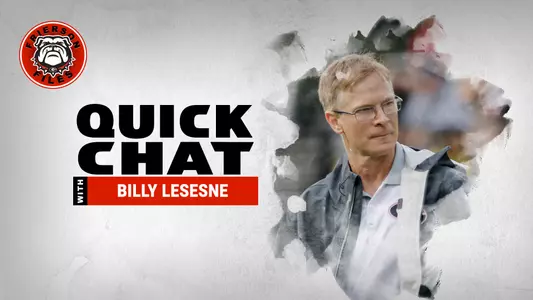
Quick Chat: Billy Lesesne
April 21, 2020 | Soccer, The Frierson Files
By John Frierson
Staff Writer
Georgia soccer coach Billy Lesesne had an extra reason to worry as the coronavirus pandemic shut down everything on campus and beyond last month. His wife, Katie, was on a service trip in Guatemala at the time and getting home was not as easy as just hopping on the next flight to Atlanta.
During a recent Quick Chat, Lesesne talked about Katie's ordeal, as well as adjusting to life without soccer and coaching. He also discussed his playing days and getting his start coaching at his alma mater, Erskine College, where he had to do a bit of everything, including lining the field himself.
Here's some of what he had to say:
Frierson: What has the transition to working from home been like for you?
Lesesne: I think we all miss the face-to-face interaction and we all recognize how impactful and how immediate that is. Now, with the planning of a Zoom meeting you've got to get everyone on the same schedule at the same time — it's always a good way to check in and that's generally what we do at the beginning part of our meetings. On a scale of 1-5, how are you doing? What's your motivation like?
Getting an opportunity to see how people are doing in isolation and they all have different family dynamics, it's just been interesting to see through these Zoom meetings. Now that we have the opportunity to supply a little bit of video content and to do a bit of a chalk talk, we're able to move a little bit past, how are you doing? Now we can ask, how are you doing with soccer? I think it's given our kids a chance to watch a little video of themselves in the past or even our spring game that we were able to get in before the changes that we've had.
I do think we've recognized ways to get to know each other in a different way and I think our players really enjoy the Zoom meetings, getting to see each other again even if it's just for a short time. We do several a week and it's enjoyable to catch up with everyone.
Frierson: How would you describe yourself as a player?
Lesesne: Boy, I was I was still playing. I think I was more of a midfield player who could go forward and get back and defend, so I liked to play on both sides of the ball. All that came to a crashing halt in my junior year in college when, we played a 4-4-2 at the time, and our sweeper head-butted a player and got red-carded. We were a man down and coach put me at center back, as the sweeper, and I had to finish out that game there and the next game because our player had to sit that one out.
Ultimately, that became my home for my junior and senior year, so I got to see the game from a different perspective as a center back later in my career. When I moved on to play for the Charleston Battery at the semi-professional level, I went back to midfield. That experience of being thrown in the fire at center back and seeing the game a different way was helpful for me as a player.
Frierson: What was it like playing for the Battery and what was life like at the semi-pro level?
Lesesne: It was the first two or three years of the Battery's existence, in the USISL (United States Interregional Soccer League), which had over 50 teams at some points. This was before the MLS started. You were able to get paid by the game and you got a little stipend for housing expenses and those type things. It was a nice little summer gig and you got to do something you enjoyed with a good group of players.
We traveled across the country and got to play in different environments which was always fun. It's not something you could live on, it was a summer activity I could do when I wasn't coaching. I enjoyed every minute of it.
Frierson: Tell me about Erskine College and Due West, S.C., which is one of the great names of all time?
Lesesne: You definitely know everyone. My grandfather had been president there at Erskine and my father worked there from when I was 3, and I ended up going to college there as well. The formative part of my childhood was on that campus and Due West is a small college town. The school had about 700 students and the town had a population of around 2,000, so very small, not a stoplight in town, so you certainly knew everyone there.
That's how I got involved with the sport. At a small college, you wear many hats and at the time my dad was the athletics director, as well. He hired a guy named Ralph Lundy to coach at Erskine and at the time I'd never seen a soccer ball. My dad hired him and my dad said, you're getting out of Little League baseball this afternoon because you're going to soccer camp, and I guess the rest was history.
Coach Lundy basically adopted a couple of other kids and myself and put us in the back of his truck and we'd roll into different small towns and put on soccer clinics. We didn't have a high school team until my junior year so when I was a freshman and sophomore in high school, I actually practiced with the college players. That certainly made you elevate your game because the players were older and at a higher competitive level.
A lot of good things came out of being in a small college town and I enjoyed my time there.
Frierson: You've got life in a small town and on a small campus like that and then you've also coached at Vanderbilt, Duke and Georgia. How different are those worlds?
Lesesne: Very different. My first college coaching job, back at Erskine, you had two teams (men's and women's) and the first couple of years there was no assistant coach. You basically lined the fields, cut the fields — you did everything.
When you move to the Vanderbilts, the Dukes, the Georgias, the support staffs that you have to help you in all those areas, it's immense and it's a completely different game that you're dealing with. I go back to those early years when you're coaching the men's and women's teams at the same time, it's like 14 seasons rolled into seven years. You gain a lot of experience really quickly.
Frierson: Now that you've got more free time, more time away from work than you'd like, are you learning anything new or picking up any new hobbies?
Lesesne: I'm actually doing a lot of video review from last season. Sometimes when you're going game to game during the season, you have to turn the page pretty quickly. Now, with the season done and the emotions in a different place, I can go back and watch games a little more critically. I can say, did we make the right sub at this time? I can look at the game without having the emotion of turning the page and looking to the next game and also without the emotion of what happened in that game.
Outside of soccer, I'm just doing things with the family. When this first started we were on spring break and came back. I was with my (three) kids and my wife, Katie, went to Guatemala. She's a physical therapist and did a service project in Guatemala.
When we got back, we were waiting for her to arrive. Well, Guatemala closed its borders, so she had to spend an extra five or six days down there and there was a lot of uncertainty about when she could come home. They worked through the embassies and were able to get her home, but during that time our kids were transitioning to online school.
We've got a 5-year-old so I was a preschool teacher from 9 to noon each day. My 15-year-old had online classes and she's in chemistry and honors history and those different things, so I was trying to help her as well. Tutoring the occasional chemistry problem was a challenge for me [laughs] and a challenge for her.
Fortunately, a few days later my wife was able to make it home. We've done a nice job of maintaining a routine, which I think is important during this time.
Frierson: What is it like having a spouse in another country when a pandemic hits?
Lesesne: There was a lot of uncertainty. She was in a safe location and I think she felt bad that she wasn't able to come home right away and be with the family. She and her group weren't able to go into the hospitals and help with the pediatric PT that they were doing which was unfortunate because that's why they were there.
Their group of 14 people was huddled together in a safe environment but they weren't allowed to go out and do anything, so she was feeling bad about not being able to help others which was their entire mission. ... She and her group were working with different embassies — most of her group came from UNC-Chapel Hill and they were working with the legislative bodies there and my wife was connecting with people in Georgia, trying to find ways to get home. It was a very interesting time and it's made our family stronger.
It was stressful for all of us but we had a great party when she came back.
(This Q&A was lightly edited for length and clarity.)
Staff Writer
Georgia soccer coach Billy Lesesne had an extra reason to worry as the coronavirus pandemic shut down everything on campus and beyond last month. His wife, Katie, was on a service trip in Guatemala at the time and getting home was not as easy as just hopping on the next flight to Atlanta.
During a recent Quick Chat, Lesesne talked about Katie's ordeal, as well as adjusting to life without soccer and coaching. He also discussed his playing days and getting his start coaching at his alma mater, Erskine College, where he had to do a bit of everything, including lining the field himself.
Here's some of what he had to say:
Frierson: What has the transition to working from home been like for you?
Lesesne: I think we all miss the face-to-face interaction and we all recognize how impactful and how immediate that is. Now, with the planning of a Zoom meeting you've got to get everyone on the same schedule at the same time — it's always a good way to check in and that's generally what we do at the beginning part of our meetings. On a scale of 1-5, how are you doing? What's your motivation like?
Getting an opportunity to see how people are doing in isolation and they all have different family dynamics, it's just been interesting to see through these Zoom meetings. Now that we have the opportunity to supply a little bit of video content and to do a bit of a chalk talk, we're able to move a little bit past, how are you doing? Now we can ask, how are you doing with soccer? I think it's given our kids a chance to watch a little video of themselves in the past or even our spring game that we were able to get in before the changes that we've had.
I do think we've recognized ways to get to know each other in a different way and I think our players really enjoy the Zoom meetings, getting to see each other again even if it's just for a short time. We do several a week and it's enjoyable to catch up with everyone.
Frierson: How would you describe yourself as a player?
Lesesne: Boy, I was I was still playing. I think I was more of a midfield player who could go forward and get back and defend, so I liked to play on both sides of the ball. All that came to a crashing halt in my junior year in college when, we played a 4-4-2 at the time, and our sweeper head-butted a player and got red-carded. We were a man down and coach put me at center back, as the sweeper, and I had to finish out that game there and the next game because our player had to sit that one out.
Ultimately, that became my home for my junior and senior year, so I got to see the game from a different perspective as a center back later in my career. When I moved on to play for the Charleston Battery at the semi-professional level, I went back to midfield. That experience of being thrown in the fire at center back and seeing the game a different way was helpful for me as a player.
Frierson: What was it like playing for the Battery and what was life like at the semi-pro level?
Lesesne: It was the first two or three years of the Battery's existence, in the USISL (United States Interregional Soccer League), which had over 50 teams at some points. This was before the MLS started. You were able to get paid by the game and you got a little stipend for housing expenses and those type things. It was a nice little summer gig and you got to do something you enjoyed with a good group of players.
We traveled across the country and got to play in different environments which was always fun. It's not something you could live on, it was a summer activity I could do when I wasn't coaching. I enjoyed every minute of it.
Frierson: Tell me about Erskine College and Due West, S.C., which is one of the great names of all time?
Lesesne: You definitely know everyone. My grandfather had been president there at Erskine and my father worked there from when I was 3, and I ended up going to college there as well. The formative part of my childhood was on that campus and Due West is a small college town. The school had about 700 students and the town had a population of around 2,000, so very small, not a stoplight in town, so you certainly knew everyone there.
That's how I got involved with the sport. At a small college, you wear many hats and at the time my dad was the athletics director, as well. He hired a guy named Ralph Lundy to coach at Erskine and at the time I'd never seen a soccer ball. My dad hired him and my dad said, you're getting out of Little League baseball this afternoon because you're going to soccer camp, and I guess the rest was history.
Coach Lundy basically adopted a couple of other kids and myself and put us in the back of his truck and we'd roll into different small towns and put on soccer clinics. We didn't have a high school team until my junior year so when I was a freshman and sophomore in high school, I actually practiced with the college players. That certainly made you elevate your game because the players were older and at a higher competitive level.
A lot of good things came out of being in a small college town and I enjoyed my time there.
Frierson: You've got life in a small town and on a small campus like that and then you've also coached at Vanderbilt, Duke and Georgia. How different are those worlds?
Lesesne: Very different. My first college coaching job, back at Erskine, you had two teams (men's and women's) and the first couple of years there was no assistant coach. You basically lined the fields, cut the fields — you did everything.
When you move to the Vanderbilts, the Dukes, the Georgias, the support staffs that you have to help you in all those areas, it's immense and it's a completely different game that you're dealing with. I go back to those early years when you're coaching the men's and women's teams at the same time, it's like 14 seasons rolled into seven years. You gain a lot of experience really quickly.
Frierson: Now that you've got more free time, more time away from work than you'd like, are you learning anything new or picking up any new hobbies?
Lesesne: I'm actually doing a lot of video review from last season. Sometimes when you're going game to game during the season, you have to turn the page pretty quickly. Now, with the season done and the emotions in a different place, I can go back and watch games a little more critically. I can say, did we make the right sub at this time? I can look at the game without having the emotion of turning the page and looking to the next game and also without the emotion of what happened in that game.
Outside of soccer, I'm just doing things with the family. When this first started we were on spring break and came back. I was with my (three) kids and my wife, Katie, went to Guatemala. She's a physical therapist and did a service project in Guatemala.
When we got back, we were waiting for her to arrive. Well, Guatemala closed its borders, so she had to spend an extra five or six days down there and there was a lot of uncertainty about when she could come home. They worked through the embassies and were able to get her home, but during that time our kids were transitioning to online school.
We've got a 5-year-old so I was a preschool teacher from 9 to noon each day. My 15-year-old had online classes and she's in chemistry and honors history and those different things, so I was trying to help her as well. Tutoring the occasional chemistry problem was a challenge for me [laughs] and a challenge for her.
Fortunately, a few days later my wife was able to make it home. We've done a nice job of maintaining a routine, which I think is important during this time.
Frierson: What is it like having a spouse in another country when a pandemic hits?
Lesesne: There was a lot of uncertainty. She was in a safe location and I think she felt bad that she wasn't able to come home right away and be with the family. She and her group weren't able to go into the hospitals and help with the pediatric PT that they were doing which was unfortunate because that's why they were there.
Their group of 14 people was huddled together in a safe environment but they weren't allowed to go out and do anything, so she was feeling bad about not being able to help others which was their entire mission. ... She and her group were working with different embassies — most of her group came from UNC-Chapel Hill and they were working with the legislative bodies there and my wife was connecting with people in Georgia, trying to find ways to get home. It was a very interesting time and it's made our family stronger.
It was stressful for all of us but we had a great party when she came back.
(This Q&A was lightly edited for length and clarity.)
John Frierson is the staff writer for the UGA Athletic Association and curator of the ITA Men's Tennis Hall of Fame. You can find his work at: Frierson Files. He's also on Twitter: @FriersonFiles and @ITAHallofFame.
Georgia Soccer NCAA First Round Postgame Interview
Friday, November 14
Georgia Women's Soccer SECs vs Kentucky Game Highlights
Wednesday, November 05
Georgia Soccer vs Auburn Post Game Interview
Sunday, October 19
Georgia Soccer vs Texas Game Highlights
Friday, October 17