University of Georgia Athletics
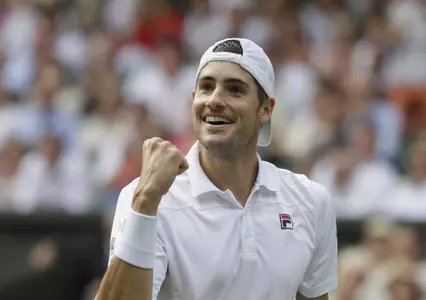
Quick Chat: John Isner
July 24, 2019 | Men's Tennis, The Frierson Files
By John Frierson
Staff Writer
ATLANTA — For more than 15 years, since he was a tall, skinny freshman on the Georgia men's tennis team, I've been talking to John Isner. Time pauses for nobody and that talented and cheerful and scrawny new Bulldog has long since been fully grown.
As we sat and talked in the lobby of the Twelve Hotel in Atlantic Station on Tuesday afternoon, our usual pre-tournament chat before he begins play Wednesday night in the BB&T Atlanta Open, an ATP Tour event he's won five times already, the 6-foot-10 Isner, now a 34-year-old husband and father, was a man in full, to steal a line from Tom Wolfe.
On Sunday, the 14th-ranked Isner earned the 15th ATP title of his career, winning the Hall of Fame Open on grass (and a lot of dirt) in Newport, R.I. On the court with him after the match were his wife Madison and their infant daughter, Hunter Grace. The lovely family, which lives in Dallas, is also expecting a son in November.
Between his career, fatherhood and life on tour in his mid-30s, there was plenty for John and me to discuss. Here's some of what he had to say during this long Quick Chat:
Frierson: You just won your 15th ATP Tour event, so does that number shock you in a way, that you've had the career you've had? Or do you just look at it as the well-earned result of a ton of hard work?
Isner: It's both — just thinking back to my college days, if somebody would have told me I'd win at this point 15 ATP singles titles, I would be like, "No way." It's hard to win a tournament. It has shocked me but I also have put in a lot of hard work, so I think it's been well earned. It has definitely shocked me, my whole career has.
There's also no doubt that I'm a creature of habit and I've played well during certain times of the year, and it seems like the same thing over and over again. Between Newport and Atlanta, I've won those tournaments a combined nine times. It's pretty crazy.
Frierson: I can remember talking to you when you were a freshman, when we first got to know each other, and at that point it struck me that for you a pro career would be a nice dream, but it wasn't something that felt all that tangible.
Isner: No, not my freshman year in college. After my freshman year, I remember my back was hurt — I was a little hurt my freshman year and didn't help out our team as much as I would have liked because I missed a lot of matches and I didn't play well in the NCAAs for us.
I just went back home to North Carolina and I didn't pick up a racket; I was like, I'll just chill out and go fishing and enjoy my summer at home. To think that I was doing that at 19 years old and not thinking about pro tennis at all, it's pretty crazy.
It was my junior year when everything really changed for me and I became a true professional at that point. Something just clicked; I was a hard worker even before that but I took it to the next level.
Frierson: What was it that clicked? Was it physically, putting on some weight?
Isner: I just knew that I'm such a big guy, it's simple: I need to take care of myself very well. A lot of that stemmed from having a bad back my freshman year and just needing to get stronger, something I never really took too seriously in juniors. I just kind of took it for granted and never was hurt, was young and going out there and playing; not stretching, not lifting weights, not doing anything.
I realized that I had to change and I literally right then and there changed.
Frierson: Say the John Isner that won up in Newport on Sunday for his 15th career title is facing off against the John Isner that was in the U.S. Open in 2007 — how badly does the current John Isner crush the one from 2007?
Isner: (Laughs) I definitely don't think crush, you know, because my serve was still there, but I'm definitely a much better player now. That just comes with experience, maturity and professionalism. I'm a much better player now and that's cool to think about — at 34 I'm a better player than I was at 28, even, not just 22 right out of college. I think I'm better now than I was five, six years ago.
Frierson: Well, physically you're so much different. You're never going to be jacked, but there's a lot more muscle on you. It's probably what Nic Claxton's going through in basketball.
Isner: Yeah, exactly. It really did take me to, no joke, 30 years old to truly grow into my body. That just speaks to (laughs) how big I am and how much it takes to feel really comfortable out there and feel comfortable in my body and grow into it.
Frierson: The last time we did this you were newly married and your daughter was on the way, so what is it like being a traveling pro now with a whole family? Do they travel with you all the time?
Isner: Not all the time. It's definitely different and everything has evolved. Prior to getting married, everything revolved around myself at all times, and now it's different. Traveling, we went to Wimbledon because we stayed at a house and there are some tournaments where it's not that easy (with a family). A tournament like this, the rooms are so big and we just love spending the time with her.
She travels well and my wife, she does it all. She does such a good job with her and keeps her on schedule all the time. She won't veer off of that. It's helped things so much; it's helped me as a person and as a player, I think, and our family's growing even more.
If I'm sitting with you next year and we have a third kid on the way (laughs), I'm saying that's not going to happen (laughs). But we'll see.
Frierson: You're 34 and you just won your 15th tournament, and so many of the top 15 guys in the world (eight) are in their 30s. You're the second-oldest behind Roger Federer (37), which probably feels weird, but what is it about this group of guys that you're all still playing at such a high level past 30? I don't know that we've ever seen this before.
Isner: No, we haven't. You obviously have Roger leading that charge and everyone looks up to him and just tries to be like him, in a sense. For me it's like, I still want to compete with him as long as possible and it doesn't seem like he's slowing down, and he's almost 38.
He's leading the charge there and the players on tour are just very professional. And to me it makes sense: here we are, it's almost 2020 and players should be playing longer, and I think players should be playing their best tennis in their low 30s, because that's what comes with maturity and with your body, taking care of yourself. To me, it makes a lot of sense, actually, but I know it hasn't been the norm at all in our sport.
Frierson: What's the most significant way that fatherhood has changed you as a player?
Isner: I think it's just taken pressure off of me as a player, which is the most important thing of all. Going out there, there are some times when I do feel pressure because I want to win, but I do a good job now of separating myself from the result. It's a cliche, but if you let a result get ahead of the process, things get all out of whack. I've done that a bunch in my career and a lot of athletes have, but now it's like, if things don't go well on the court, life is fine and I'm not going to lose a wink of sleep.
Of course, if I lose a match when I had 12 match points, that's going to be tough, but just go out there and give my all, compete my hardest, act the right way on the court and whatever happens I'm a winner no matter what because I get to go back to my beautiful family. I know a lot of athletes say that, but it's so true. ...
I feel like I could, if I wanted to, stop playing and I would be very happy with my career. That's not going to happen, but I think I've done a good enough job up to this point where that's the case now. To me, that kind of takes some pressure off.
Frierson: You strike me as being more comfortable in your own skin now than you've ever been.
Isner: Oh, I used to not be, totally. I was really tall and skinny and I wouldn't want to be around a lot of people, and I've changed, I've changed a lot. I stick out and I'm always going to stick out, but I've embraced that and I love that and I'm very comfortable with that.
I think I've used my height to my advantage (laughs), playing tennis; it's definitely a gift and I'm very comfortable in my own skin now. I've evolved and each and every year I continue to evolve.
Frierson: Speaking of the future, do you have a plan for when you want to wrap up your career or is it all based on how you feel and how you're playing?
Isner: There's no plan, really. One of my goals this year, and I think it's very attainable, is to finish top 20 in the world — that would be 10 years in a row of that, and that's pretty consistent. I don't know, we'll see.
If my game level dips off then I probably won't be trying to play, ranked 60 or 70 in the world. If I find that my level is 60 or 70 in the world, I'll be done, I'll be fine walking away. I don't know, I can't put a timetable on it. It could be two years, it could be six years, I don't know. We'll see.
Frierson: When you had your foot injury (in the finals of the Miami Open, in March), was that an uh-oh moment because you're at an age, especially given your size, when that has the potential to be a career-ender?
Isner: Great question. Yes, especially with my size and the injury that I had. It was a full fracture of my foot and that's a classic, prototypical big man injury. I pride myself on avoiding those injuries and it hit me hard. I would wake up week after week after week and my foot would still hurt. I was getting very frustrated with it and I'm thinking, is my foot ever going to heal?
I did know that eventually it was going to heal, it just takes time and there's nothing you can really do with bone. The younger you are, the quicker you heal; like when you're 10 years old and you break your arm or something, it heals very quickly. It's natural that when you get a little older, bone takes a lot longer to heal, especially with my foot being so far away from my heart. It literally could not be further away, getting blood down to that area.
It took a long time but I had confidence that once I got over this, I would just be happy that I'm healthy and that eventually, I would get a good level back because I was playing very well prior to that.
Frierson: What's the best live performance you've ever seen?
Isner: Oh, that's easy: the Rose Bowl. Hands down, Georgia-Oklahoma. I don't think anything will ever top that.
Frierson: When you're traveling abroad for a long period, what thing that you eat here in the States do you miss the most?
Isner: Publix (laughs). I love Publix. Living in Florida for so long, that's one thing I miss because they're everywhere in Florida.
Frierson: What's in the Publix that you can't find everywhere?
Isner: Grocery stores aren't the same over there, ... but the answer to your question is a sweet potato. You can get that at any restaurant pretty much, here. Not in Europe. It's my favorite food. Peaches, you can't get peaches over in Europe, especially the peaches you get in this part of the world this time of year.
Frierson: So the Southerner in you really comes out in the things you miss.
Isner: Oh, yeah, for sure.
(This Q&A was lightly edited for length and clarity.)
John Frierson is the staff writer for the UGA Athletic Association and curator of the ITA Men's Tennis Hall of Fame. You can find his work at: Frierson Files. He's also on Twitter: @FriersonFiles and @ITAHallofFame.