University of Georgia Athletics

Aggressive Serving Paying Off
September 15, 2016 | Volleyball
By John Frierson
UGAAA Staff Writer
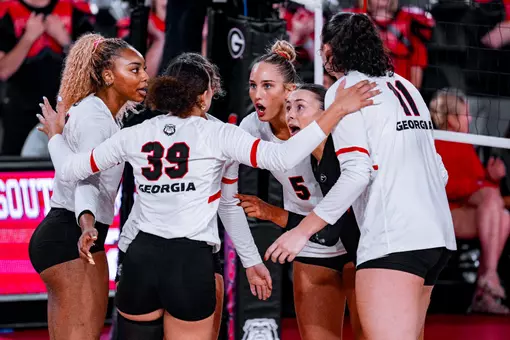
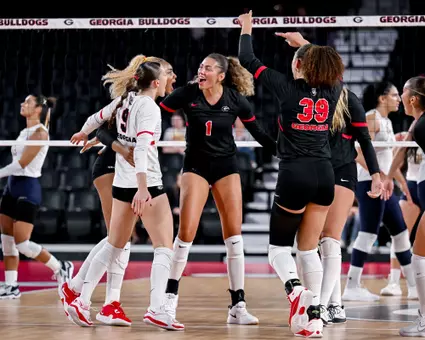
In 30 games last season, the Georgia volleyball team served a total of 106 aces. Through 10 games in 2016, the Bulldogs already have 66 and are on pace to nearly double their total from the year before.
Serving is just one area in which Georgia is showing a lot of improvement from a year ago. The Bulldogs are better in all phases of the game, which is why the team has a record of 9-1 going into this weekend's Bulldog Invitational after finishing 5-25 in 2015.
"One of our goals for this year is to get better serving," said junior Cassidy Anderson, who is tied for first in the SEC with 19 aces. "It's real easy (to play better) when you get a good serve and you're not just giving them another point."
In tennis, the server is the offensive player — just look at former Georgia star John Isner, who ranks sixth all-time on the ATP tour with 8,419 aces. In volleyball, as in baseball, the server (like the pitcher) is part of the defense, and the better and harder to handle the offering, the tougher it is for the receiving side to mount a scoring threat.
Good serving can cause problems for the defense and even get you easy points, with aces. Georgia has two of the top servers in the SEC, in terms of aces, with Anderson tied for the league lead at 19 and junior Maddie Lobenstein right behind with 17. As a team, Georgia's 66 is tops, despite playing fewer sets than six other schools, and the Dogs' 1.89 ace-per-set average is also first.
"We want our serve to be a part of our defense," coach Lizzy Stemke said. "We want to put the pressure on from the service line and I think we have the weapons to do that.
"We're talking about being really aggressive and accurate, so we do a lot of serving in our gym, putting targets out, and this year actually we've been getting out a radar gun and making sure that we're putting pace on the ball."
New assistant coach Diego Castaneda, like pitching coaches keeping a watchful eye on a hurler's velocity, clocks Georgia's servers' speeds in practice. Generally, Georgia wants serves between 38-42 miles per hour, Stemke said.
Baseball has different pitchers with different pitchers and servers have different serves. The 5-foot-8 Anderson offers up a "jump float" serve, something akin to a knuckleball — a (hopefully) no-spin serve that is going to dip and die once it crosses the net. The 6-3 Lobenstein, meanwhile, uses her size for a power serve.
Pace and spin are only two parts of the serving equation. There's also the key element of placement, which begins with scouting the other team and figuring out either a weak link or whom you want to take out of the play, if possible.
"Diego is calling all of our spots, so the girls are looking to the bench," Stemke said, "and the serve is based on the defense we want to run and the situation that we would like to put our opponent in."
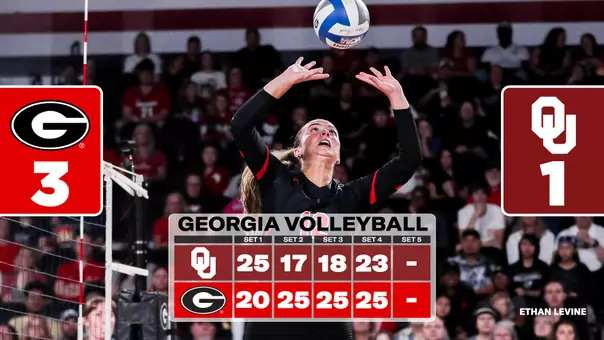
In Georgia's 3-1 win over Florida A&M on Tuesday, the Bulldogs had an up-and-down serving night. But the match did show off the benefits of a hard-to-handle serve, when Georgia won six straight points in the second set on Lobenstein's serve, turning a tie into an 8-2 advantage.
"When someone gets back there and just rips it, and just keeps going, it's a game changer," Anderson said.
Aggressive serving is a major goal for Georgia this season, but there are risks. Georgia finished Tuesday's match with eight aces in four sets, but also seven service errors. Just as an ace is an easy point for the serving side, a missed serve is as easy a point as the other side can get.
For the season Georgia has those 66 aces, as well as 84 service errors, while their opponents, cumulatively, have 35 aces and 56 errors.
"I think it's very tough to balance, especially as you get further and further into the match, when it's close and you want to get (the serve) over but also get it over aggressively into the range that we want to serve it in," Lobenstein said. "If you have an error, at least you're being aggressive and not just kind of lollipopping it in."
So no lollipops for the Bulldogs — it's a strategy that's working.
John Frierson is the staff writer for the UGA Athletic Association and curator of the ITA Men's Tennis Hall of Fame. You can find his work at: Frierson Files. He's also on Twitter: @FriersonFiles and @ITAHallofFame.