
University of Georgia Athletics
Steeplechase Not Your Typical Race
April 03, 2015 | Track & Field
By John Frierson
UGAAA Staff Writer
ATHENS, Ga. -- What's to be made of track and field's steeplechase, one of the most odd and unorthodox events in sports?
What's not to love about a single event that is a proving ground for speed, endurance and athleticism unlike any other, while also giving you the potential for so much YouTube fodder? Google "steeplechase fall" and clear your schedule for the afternoon.
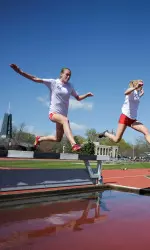
There's the distance running element, hurdles (something distance runners don't normally have to contend with) and the water jump, which gives the whole thing the feel of something you'd see on "Wipeout" or Nickelodeon, where the pit would surely be filled with green slime.
"It's definitely a race where you have to stay very focused the whole time," said Lady Bulldog runner Bret McDaniel, who began running the steeplechase last year. "You can't exactly zone out or a barrier will come up and you'll be like, oh yeah, I have to jump again. It keeps you focused and it keeps you in tune with the race, which is good. That's what I like about it: it's a little bit more mentally stimulating."
And physically demanding.
"It's totally different doing it in a race," said UGA senior Brendan Hoban, who ran the event in 9:11.55 at last year's SEC Championships, placing ninth and taking over the No. 10 spot in the school record books. "When you're fresh, it's easy. When it's the fifth or sixth lap of the race, you start to get tired and your legs aren't jumping as high."
Georgia's steeplechase runners will make their spring debut today at the Florida Relays. They will do so after a lot of training and practice -- there's a difference.
All runners and sprinters certainly have to train and condition themselves, getting unbelievably fit and strong. For the 3,000-meter (1.84 mile) steeplechase, runners also have to practice (and practice and practice) going over hurdles and going from the hurdle to over the water jump.
A couple of weeks ago, when Georgia assistant track coach Patrick Cunniff, who coaches the Bulldog distance runners, was having his squads do the water jump for the first time this spring, he seemed a bit nervous.
"Everybody say a little prayer," he said before the first attempt.
The first day of practice wasn't great -- there were too many stutter-steps before hurdles and not enough jumps in stride -- but a foundation was laid. And nobody got hurt.
Because the steeplechase is a rare event at high school meets, Cunniff said recruiting runners for the race doesn't happen much. Instead, not unlike looking at a good high school linebacker and projecting whether he could be a good collegiate safety, coaches have to look for certain traits in a runner and determine if they will translate to this most unusual event.
"A lot of times you like someone that has played other sports," he said. "A lot of times someone who has a soccer or basketball background is a little bit more ready to do well in the steeple. Or as you're going through cross-country and you see someone who's kind of got a combination of toughness and athleticism, that's a good sign because it's a hard event."
Steeplechase apparently got its running start as a cross-country event in England, at the University of Oxford in 1850. It first appeared at the Olympics in 1920.
A 3,000-meter race features seven laps and 35 total hurdles, with seven being water jumps. Of course they're not the same hurdles used in other track events. Those are light and go over easily when clipped by a heel or leg. Steeplechase hurdles are basically immobile, so a poorly executed jump will be a lot like a bad hop over a brick wall.
And that explains all the stutter-stepping on that first day of practice.
Unlike the sprints or regular distance events, which are highly technical and where precision can be paramount, there is an element of play in the steeplechase. Once you're comfortable with the water jump, and have figured out how to land with one foot in the water and maintain your stride so you don't lose momentum, it's easy to see something fun or playful in the endeavor.
"There's an excitement around it," Hoban said, "and that's why it draws the crowd."
"You never know who's going to fall and the hurdles put a lot more elements into it than just running around the track," McDaniel said.
And that brings us to the YouTube or "America's Funniest Home Videos" factor. With as many as two dozen or so competitors in a crowded steeplechase race, all vying for space around each of the hurdles, and one of them involves a leap over water, failure is definitely an option.
"They're pretty funny," McDaniel said of the videos all over the Internet. "If you're not taught right how to do it, you can definitely mess up pretty easily. And it's very counter-intuitive, having to increase your speed as you go toward a barrier, in order to have the momentum to go over.
"If you go over slowly, you're going to just plop right down in the middle of the pit."
Speed, endurance, athleticism, a fun spirit and funny falls: the steeplechase may just be the perfect event for 2015. It's certainly never dull.
John Frierson is a staff writer for the UGA Athletic Association and curator of the ITA Men's Hall of Fame at the Dan Magill Tennis Complex. Follow him on Twitter: @TheFrierson and @ITAHallofFame.
UGAAA Staff Writer
ATHENS, Ga. -- What's to be made of track and field's steeplechase, one of the most odd and unorthodox events in sports?
What's not to love about a single event that is a proving ground for speed, endurance and athleticism unlike any other, while also giving you the potential for so much YouTube fodder? Google "steeplechase fall" and clear your schedule for the afternoon.
There's the distance running element, hurdles (something distance runners don't normally have to contend with) and the water jump, which gives the whole thing the feel of something you'd see on "Wipeout" or Nickelodeon, where the pit would surely be filled with green slime.
"It's definitely a race where you have to stay very focused the whole time," said Lady Bulldog runner Bret McDaniel, who began running the steeplechase last year. "You can't exactly zone out or a barrier will come up and you'll be like, oh yeah, I have to jump again. It keeps you focused and it keeps you in tune with the race, which is good. That's what I like about it: it's a little bit more mentally stimulating."
And physically demanding.
"It's totally different doing it in a race," said UGA senior Brendan Hoban, who ran the event in 9:11.55 at last year's SEC Championships, placing ninth and taking over the No. 10 spot in the school record books. "When you're fresh, it's easy. When it's the fifth or sixth lap of the race, you start to get tired and your legs aren't jumping as high."
Georgia's steeplechase runners will make their spring debut today at the Florida Relays. They will do so after a lot of training and practice -- there's a difference.
All runners and sprinters certainly have to train and condition themselves, getting unbelievably fit and strong. For the 3,000-meter (1.84 mile) steeplechase, runners also have to practice (and practice and practice) going over hurdles and going from the hurdle to over the water jump.
A couple of weeks ago, when Georgia assistant track coach Patrick Cunniff, who coaches the Bulldog distance runners, was having his squads do the water jump for the first time this spring, he seemed a bit nervous.
"Everybody say a little prayer," he said before the first attempt.
The first day of practice wasn't great -- there were too many stutter-steps before hurdles and not enough jumps in stride -- but a foundation was laid. And nobody got hurt.
Because the steeplechase is a rare event at high school meets, Cunniff said recruiting runners for the race doesn't happen much. Instead, not unlike looking at a good high school linebacker and projecting whether he could be a good collegiate safety, coaches have to look for certain traits in a runner and determine if they will translate to this most unusual event.
"A lot of times you like someone that has played other sports," he said. "A lot of times someone who has a soccer or basketball background is a little bit more ready to do well in the steeple. Or as you're going through cross-country and you see someone who's kind of got a combination of toughness and athleticism, that's a good sign because it's a hard event."
Steeplechase apparently got its running start as a cross-country event in England, at the University of Oxford in 1850. It first appeared at the Olympics in 1920.
A 3,000-meter race features seven laps and 35 total hurdles, with seven being water jumps. Of course they're not the same hurdles used in other track events. Those are light and go over easily when clipped by a heel or leg. Steeplechase hurdles are basically immobile, so a poorly executed jump will be a lot like a bad hop over a brick wall.
And that explains all the stutter-stepping on that first day of practice.
Unlike the sprints or regular distance events, which are highly technical and where precision can be paramount, there is an element of play in the steeplechase. Once you're comfortable with the water jump, and have figured out how to land with one foot in the water and maintain your stride so you don't lose momentum, it's easy to see something fun or playful in the endeavor.
"There's an excitement around it," Hoban said, "and that's why it draws the crowd."
"You never know who's going to fall and the hurdles put a lot more elements into it than just running around the track," McDaniel said.
And that brings us to the YouTube or "America's Funniest Home Videos" factor. With as many as two dozen or so competitors in a crowded steeplechase race, all vying for space around each of the hurdles, and one of them involves a leap over water, failure is definitely an option.
"They're pretty funny," McDaniel said of the videos all over the Internet. "If you're not taught right how to do it, you can definitely mess up pretty easily. And it's very counter-intuitive, having to increase your speed as you go toward a barrier, in order to have the momentum to go over.
"If you go over slowly, you're going to just plop right down in the middle of the pit."
Speed, endurance, athleticism, a fun spirit and funny falls: the steeplechase may just be the perfect event for 2015. It's certainly never dull.
John Frierson is a staff writer for the UGA Athletic Association and curator of the ITA Men's Hall of Fame at the Dan Magill Tennis Complex. Follow him on Twitter: @TheFrierson and @ITAHallofFame.




Sunday, June 14
Sunday, June 14
Sunday, June 14
Saturday, June 13